 ██████╗ ███████╗███████╗██████╗ ███████╗███████╗████████╗   ███████╗██╗  ██╗██╗   ██╗
 ██╔══██╗██╔════╝██╔════╝██╔══██╗██╔════╝██╔════╝╚══██╔══╝   ██╔════╝██║ ██╔╝╚██╗ ██╔╝
 ██║  ██║█████╗  █████╗  ██████╔╝█████╗  ███████╗   ██║      ███████╗█████╔╝  ╚████╔╝
 ██║  ██║██╔══╝  ██╔══╝  ██╔═══╝ ██╔══╝  ╚════██║   ██║      ╚════██║██╔═██╗   ╚██╔╝
 ██████╔╝███████╗███████╗██║     ███████╗███████║   ██║      ███████║██║  ██╗   ██║
 ╚═════╝ ╚══════╝╚══════╝╚═╝     ╚══════╝╚══════╝   ╚═╝      ╚══════╝╚═╝  ╚═╝   ╚═╝
◄ BEN BROWN // WESTERN AUSTRALIA ►
.
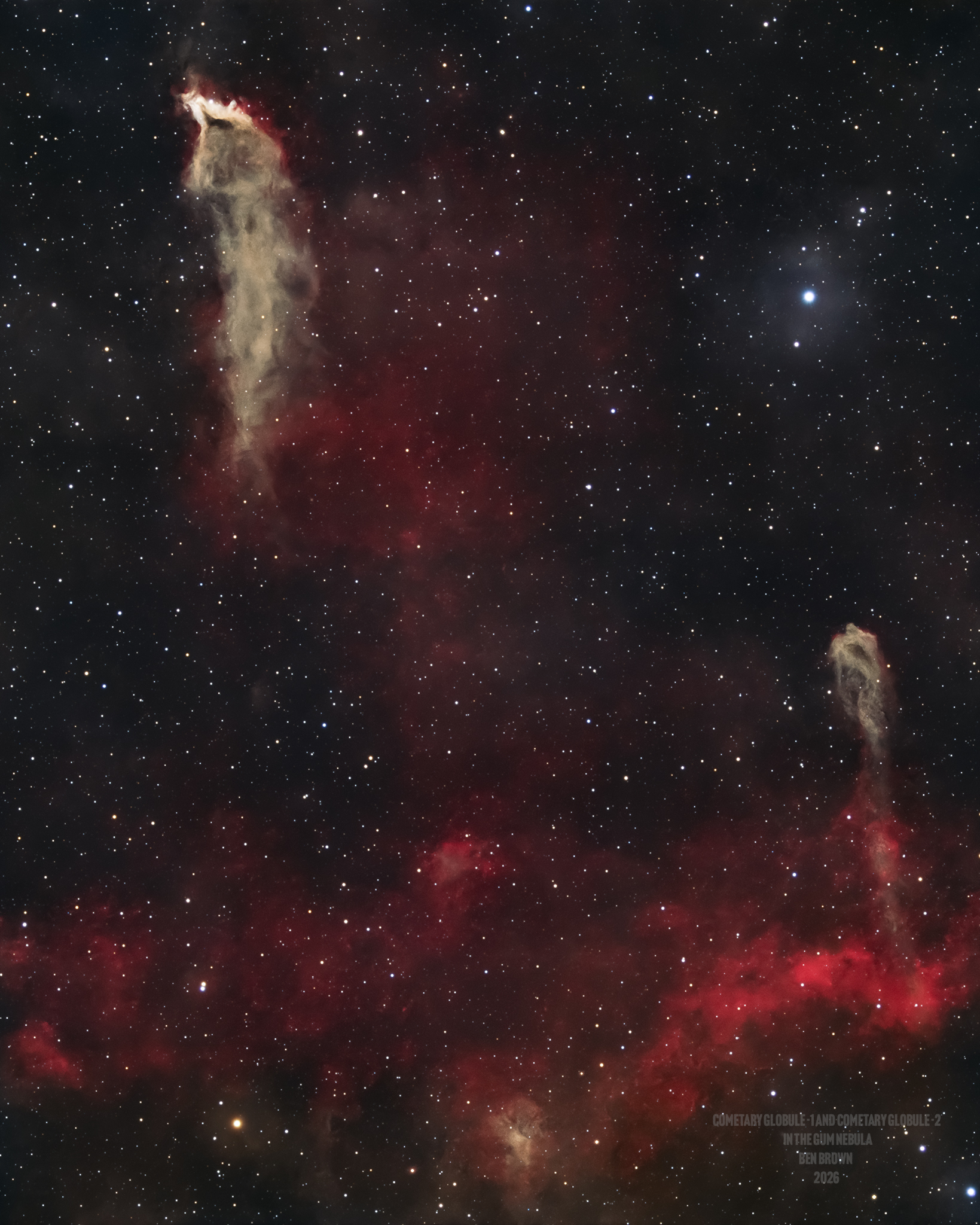
Cometary globules are among the most striking and mysterious structures in the southern sky. Unlike anything else in astronomy, they look exactly like comets each one a bright, dense head trailing a long luminous tail stretching away from a central ionising source. But they are not comets. Each globule is a dense knot of cold molecular gas, typically containing enough material to form a star or two, embedded inside the vast Gum Nebula -- an ancient supernova remnant and HII complex spanning nearly 40 degrees of sky. Radiation from hot stars deep inside the Gum Nebula, particularly the hot blue star Zeta Puppis, is driving a powerful ionisation front that sculpts the globules and blows their outer layers into the distinctive tails. CG 1 shows a clear bright-rimmed head with a long sweeping tail. CG 2 to the lower right has a more compact form. Both are thought to be active sites of star formation, compressed by the very radiation that is also eroding them.
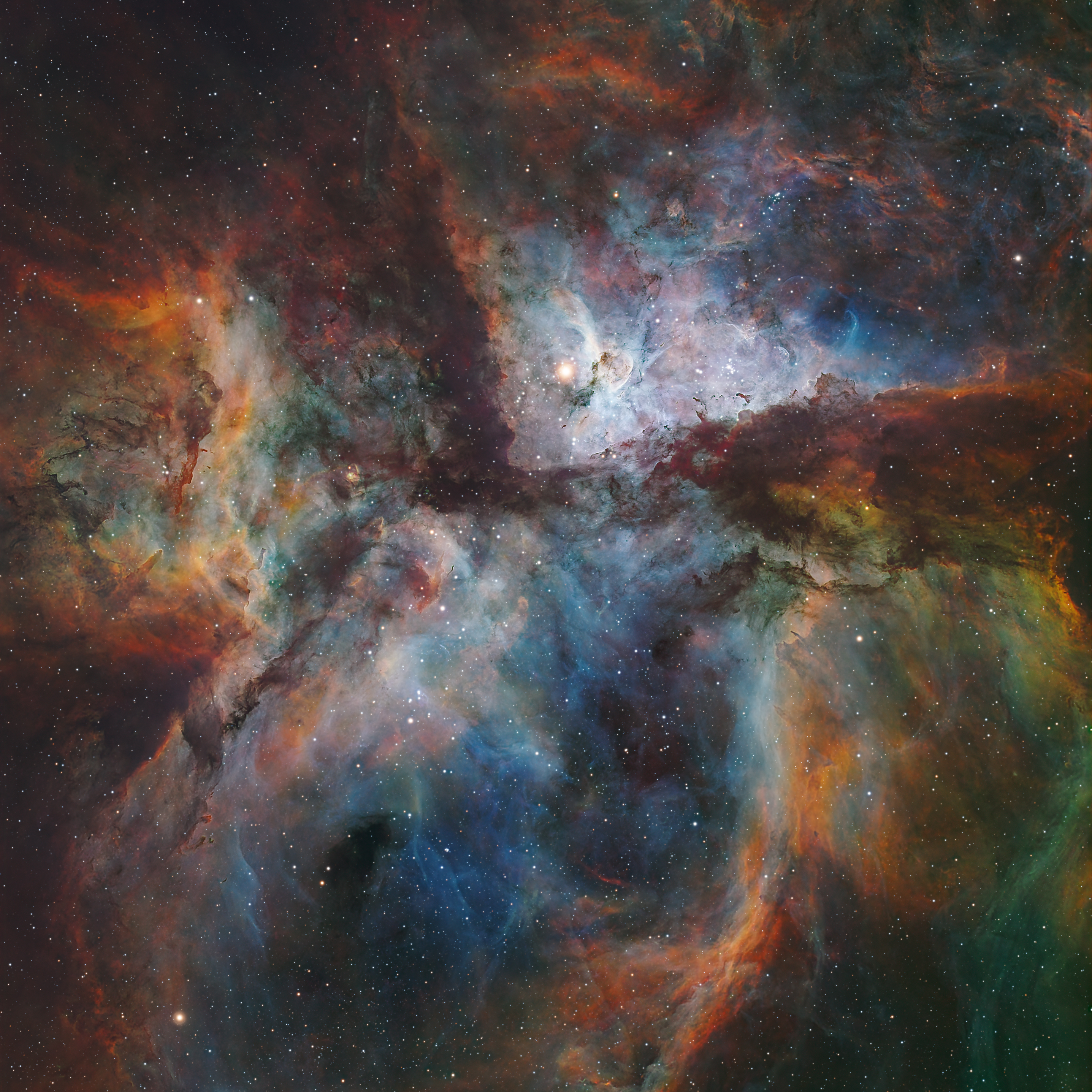
One of the largest and most luminous nebulae in the Milky Way, NGC 3372 spans over 300 light-years in the constellation Carina and sits roughly 8,500 light-years away. For observers in Western Australia it rises high overhead — a privilege denied to the entire northern hemisphere. At the heart of this nebula resides Eta Carinae itself, a hypergiant estimated at 100–150 solar masses and a candidate for an imminent supernova or hypernova. During the Great Eruption of the 1840s it briefly became the second-brightest star in the sky, ejecting several solar masses of material that now form the tiny hourglass-shaped Homunculus Nebula surrounding it.
The Keyhole Nebula — a cold dark molecular cloud near the centre — has resisted the intense ionising radiation for tens of thousands of years. The hot star clusters Trumpler 14 and 16 blaze within the complex, containing some of the youngest and hottest O-type stars in the Galaxy, sculpting and illuminating the surrounding gas with ultraviolet radiation. My 2026 SHO narrowband rendering maps sulphur-II to red, hydrogen-alpha to green, and oxygen-III to blue — revealing the layered chemistry of the nebula in extraordinary detail across every scale from vast curtains of gas to fine filamentary structures.
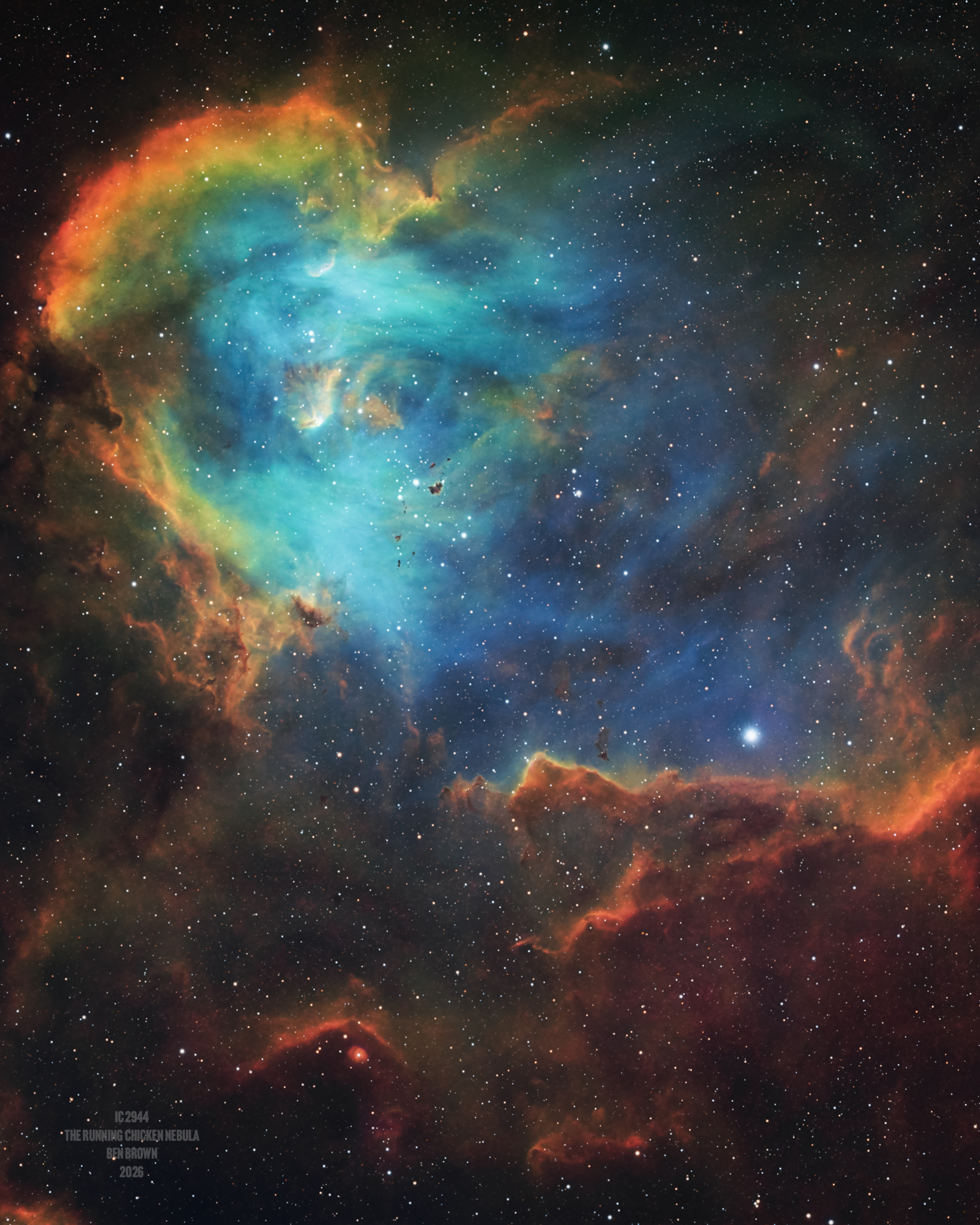
IC 2944 is a luminous emission nebula and star-forming complex approximately 6,000 light-years away in Centaurus. Energised by the embedded open cluster IC 2948 — whose hot O and B-type stars are less than a few million years old — the nebula blazes with ionised hydrogen and oxygen in constant turmoil. The name refers to the wider complex silhouette at low resolution, but close-up reveals a breathtaking landscape of detail.
Perhaps the most scientifically famous features are the Bok globules first catalogued by astronomer Bart Bok: small dark round knots of dense molecular gas silhouetted against the bright emission behind them. These dark teardrop shapes are potential sites of ongoing star formation — or they may be slowly evaporating under assault from nearby stellar radiation. Their survival is still actively debated by researchers.
In SHO narrowband, the turbulent interface between ionised hydrogen (vivid teal) and sulphur-rich gas (orange-red) creates dramatic visual contrast. My 2026 rendition captures structural detail across the full field — from the brilliant inner cavity to the delicate outer wisps extending beyond. The dark Bok globules are clearly resolved and stand as tiny monuments to the uncertainty of star birth in a violent radiation environment.
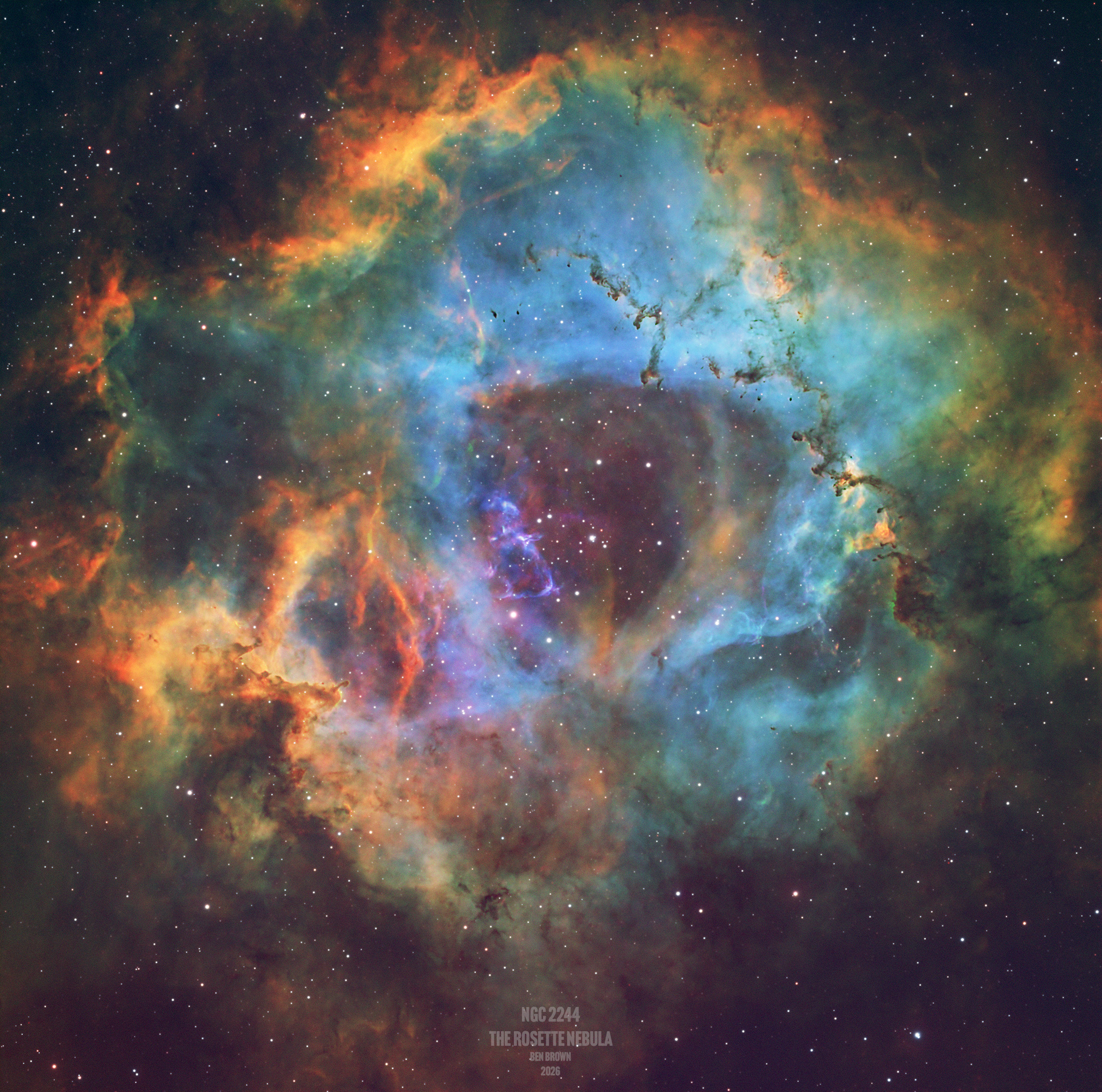
The Rosette Nebula is one of the most recognisable objects in astronomy — a vast circular emission nebula 5,200 light-years away in Monoceros. Its near-perfect ring of glowing gas surrounding a hollow central cavity makes it unmistakeable in any long-exposure photograph. At the heart sits open cluster NGC 2244, containing dozens of young O-type stars formed within the last five million years from the very molecular cloud that now surrounds them.
Their powerful stellar winds and ultraviolet radiation have blown the surrounding gas outward, carving a cavity roughly 50 light-years wide. The stars are actively destroying their own birthplace. Elephant trunk structures protrude inward from the ring — dense pillars that are sites of triggered star formation, compressed by the expanding ionisation front advancing outward from the central cluster.
My SHO image reveals the Rosette's extraordinary chromatic complexity. The blue-teal inner cavity, warm golden ring of hydrogen emission, and intricate fibrous structure connecting them create an image that rewards close examination at every scale. The contrast between the soft inner void and the intense outer ring boundary is captured with exceptional fidelity. Narrowband imaging transforms this classic target into something almost otherworldly — layers of chemistry made visible.
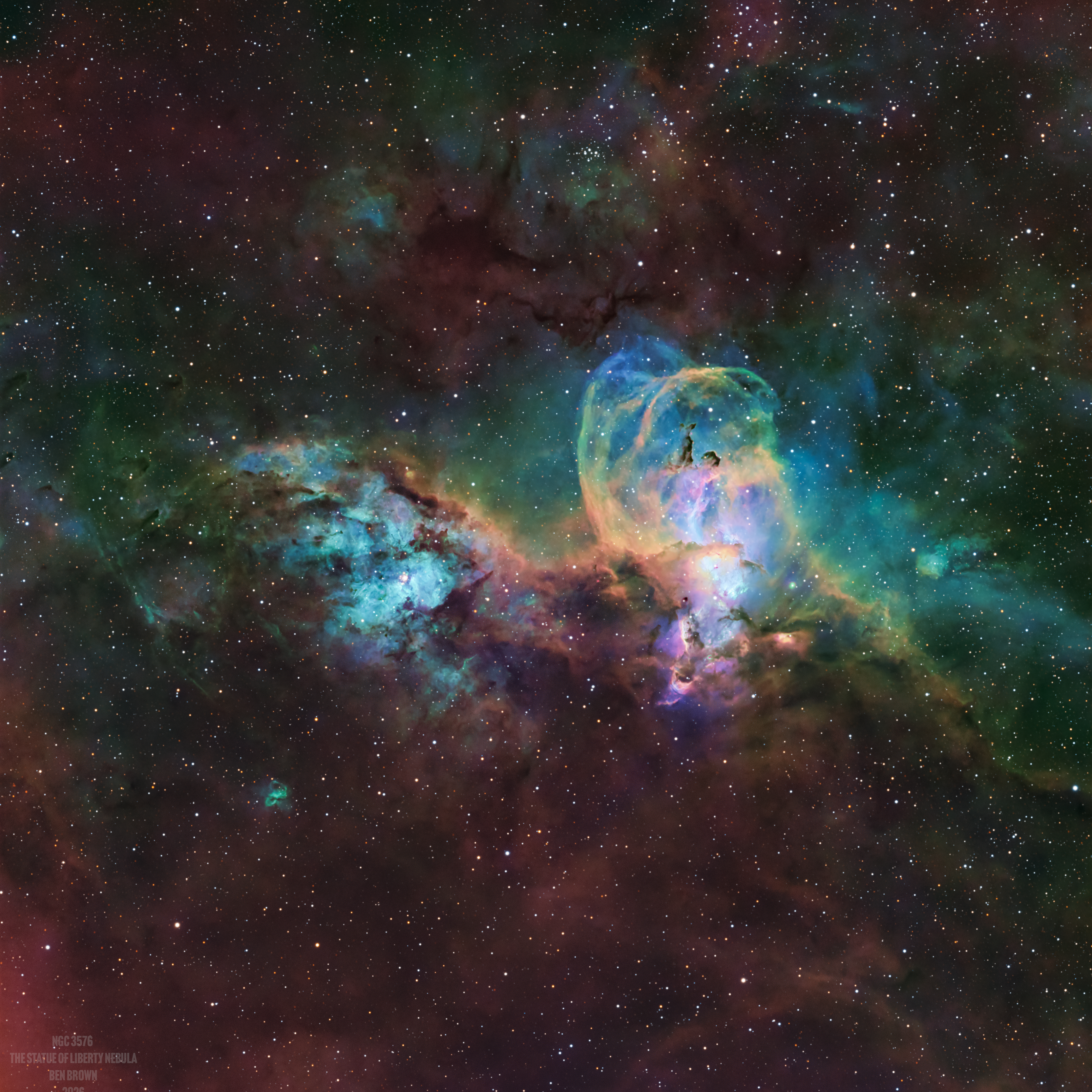
NGC 3576 sits approximately 9,000 light-years from Earth in Carina. Despite sharing the same patch of sky as the Carina Nebula, it is an entirely separate physical complex much closer to us, with its own remarkable character. The popular name comes from a distinctive curved filament of gas resembling the torch and arm of the Statue of Liberty — a massive loop of ionised gas likely produced by energetic outflows from the embedded star cluster at the nebula's core.
The central region blazes with fierce stellar radiation, creating a bright cavity surrounded by arching tendrils of glowing gas. Dark molecular clouds weave through the field creating a layered three-dimensional effect, while gas pillars are being actively sculpted by intense radiation from newly formed massive stars — a vivid illustration of the stellar feedback processes regulating star formation across the galaxy.
The delicate aquamarine and green oxygen-III emission contrasts beautifully against the warm reddish sulphur and hydrogen regions. The Liberty torch bubble on the right is rendered with remarkable clarity, and the surrounding field shows extensive faint emission often missed in shorter integrations. A great image of an underrated and scientifically rich object.
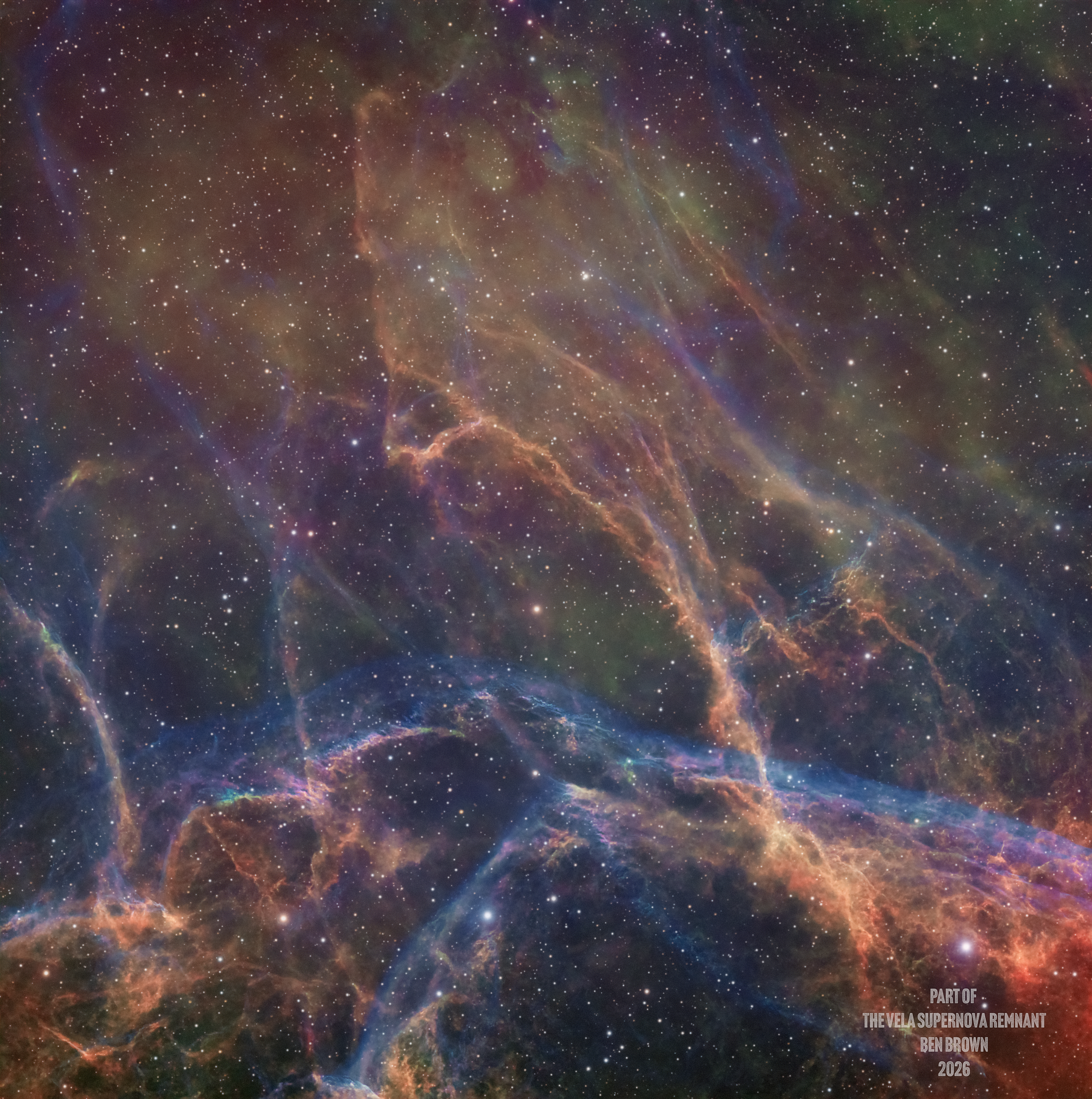
The Vela Supernova Remnant is the shockwave fossil of a massive star that detonated roughly 11,000 years ago, close enough to have been visible in daylight from Earth. At only 800 light-years away it is one of the nearest supernova remnants to our solar system, and its apparent diameter on the sky spans nearly eight degrees — making it one of the largest objects in the southern sky, far too vast to capture in a single frame at any meaningful resolution.
What you are seeing here is a section of that expanding shell — a frozen moment in a very slow explosion. The glowing filaments are not clouds of gas being illuminated from outside, but the shock front itself: the original stellar ejecta and swept-up interstellar material compressed and heated to tens of thousands of Kelvin as the blast wave ploughs outward at hundreds of kilometres per second. The delicate blue OIII ribbons mark the leading edge of that front, while the warmer Ha and SII tones behind them trace the cooling, turbulent wake. The layering of those filaments — some sharp-edged and defined, others diffuse and feathering into the background — reflects variations in the density of the interstellar medium the shockwave has encountered over millennia.
At the heart of the original remnant sits a pulsar spinning 11 times per second, all that remains of a star many times more massive than our Sun. This image captures none of that — just the outermost consequence of its death, still travelling outward 110 centuries later.
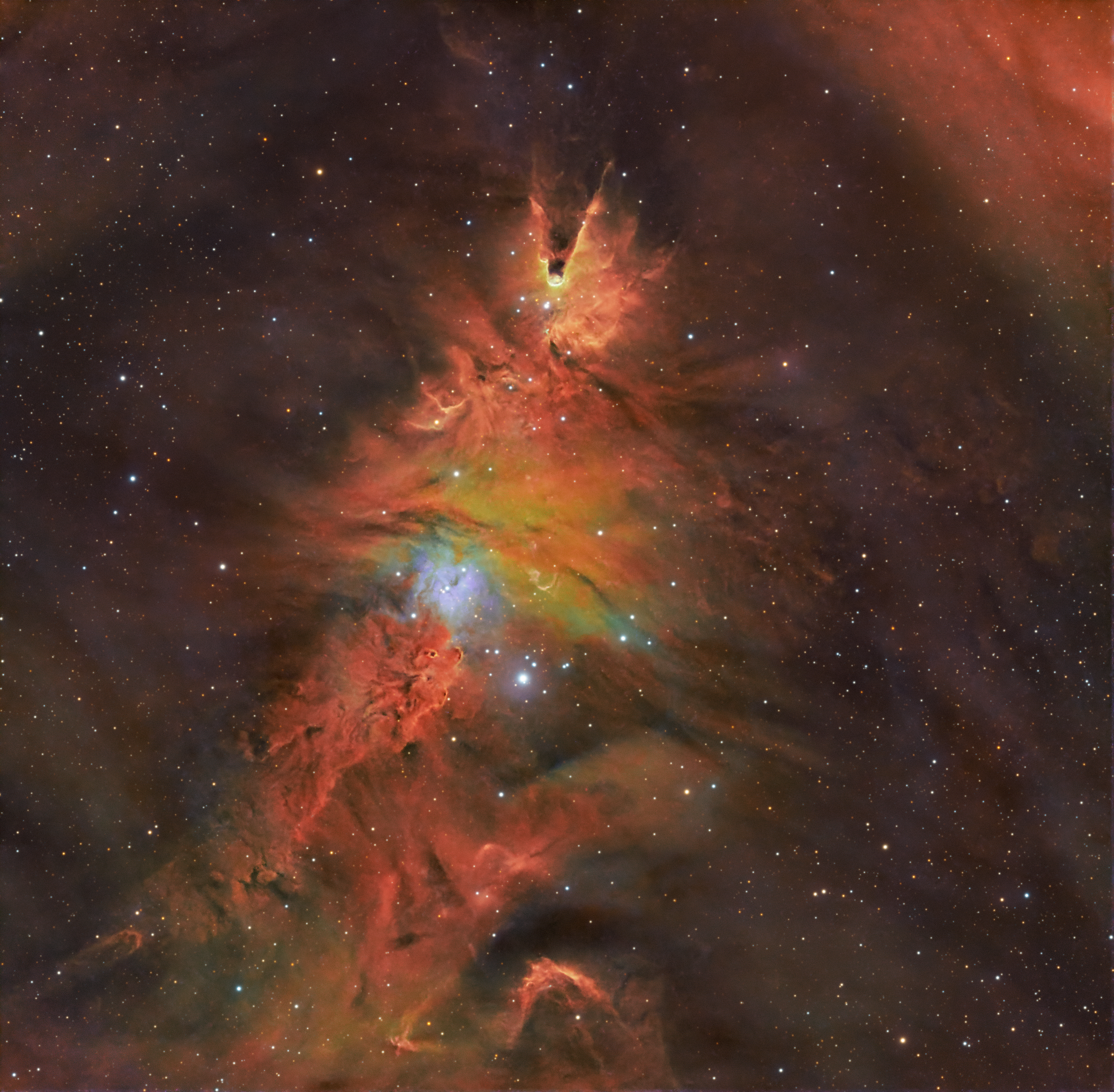
NGC 2264 is a sprawling star-forming complex in Monoceros, roughly 2,700 light-years away, centred on two of the most visually striking structures in the winter sky — the Cone Nebula and the Christmas Tree Cluster. The iconic dark cone itself is a dense pillar of cold molecular gas pointing downward into the HII region, its tip being slowly eroded and backlit by the fierce ultraviolet output of the young massive star S Monocerotis and its companions. It is a textbook example of a cometary globule in the process of being photoevaporated from the outside in.
The wider field here reveals the full character of the NGC 2264 complex — a turbulent landscape of swept emission, bright-rimmed clouds, and glowing filaments radiating outward from the central cluster. The warm SHO palette brings out the layered structure: sulphur and hydrogen emission painting the broad swept arcs in amber and orange, while oxygen-III traces the hotter, more energetic zones around the young stellar population in cooler blue-green tones. The interplay between the two tells the story of a region in active transition — gas being ionised, compressed, and driven outward simultaneously.
.
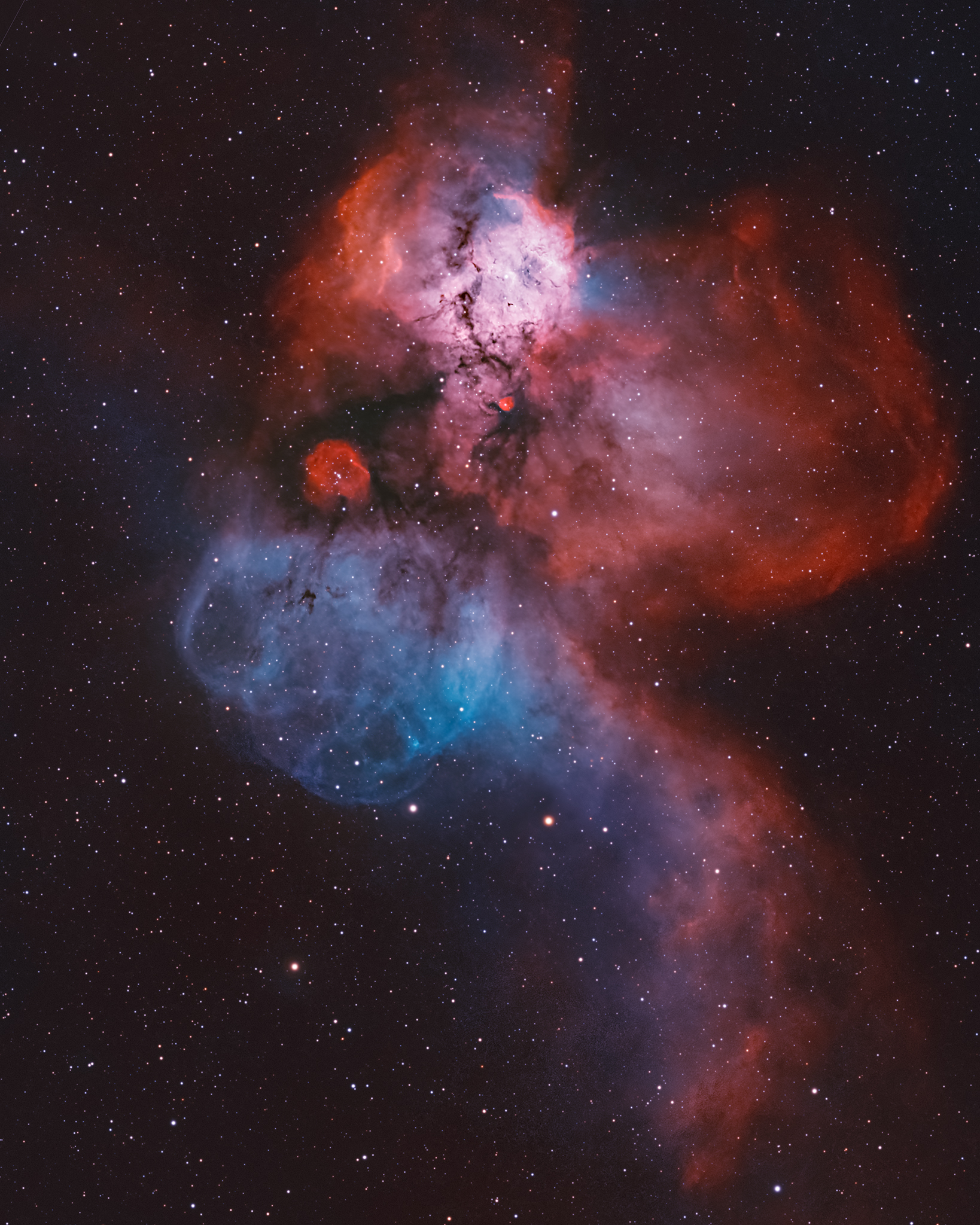
NGC 2467 is a spectacular star-forming region in Puppis, approximately 17,000 light-years away — one of the most distant objects in my portfolio, making the detail captured here all the more remarkable. The complex loosely resembles a skull when viewed at the right orientation, with two prominent bright condensations forming the eye sockets and swirling gas below suggesting a jawline. It is an active stellar nursery containing multiple star clusters of different ages embedded within the same molecular cloud.
The bright knots at upper centre are Haffner 18 and 19 — young open clusters whose ultraviolet output drives ionisation of the surrounding hydrogen gas. The blue lower lobe is particularly rich in oxygen-III emission, indicating highly ionised plasma with temperatures exceeding 10,000 Kelvin. Dark lanes and elephant-trunk structures weave through the field at various scales, sites of ongoing or future star formation.
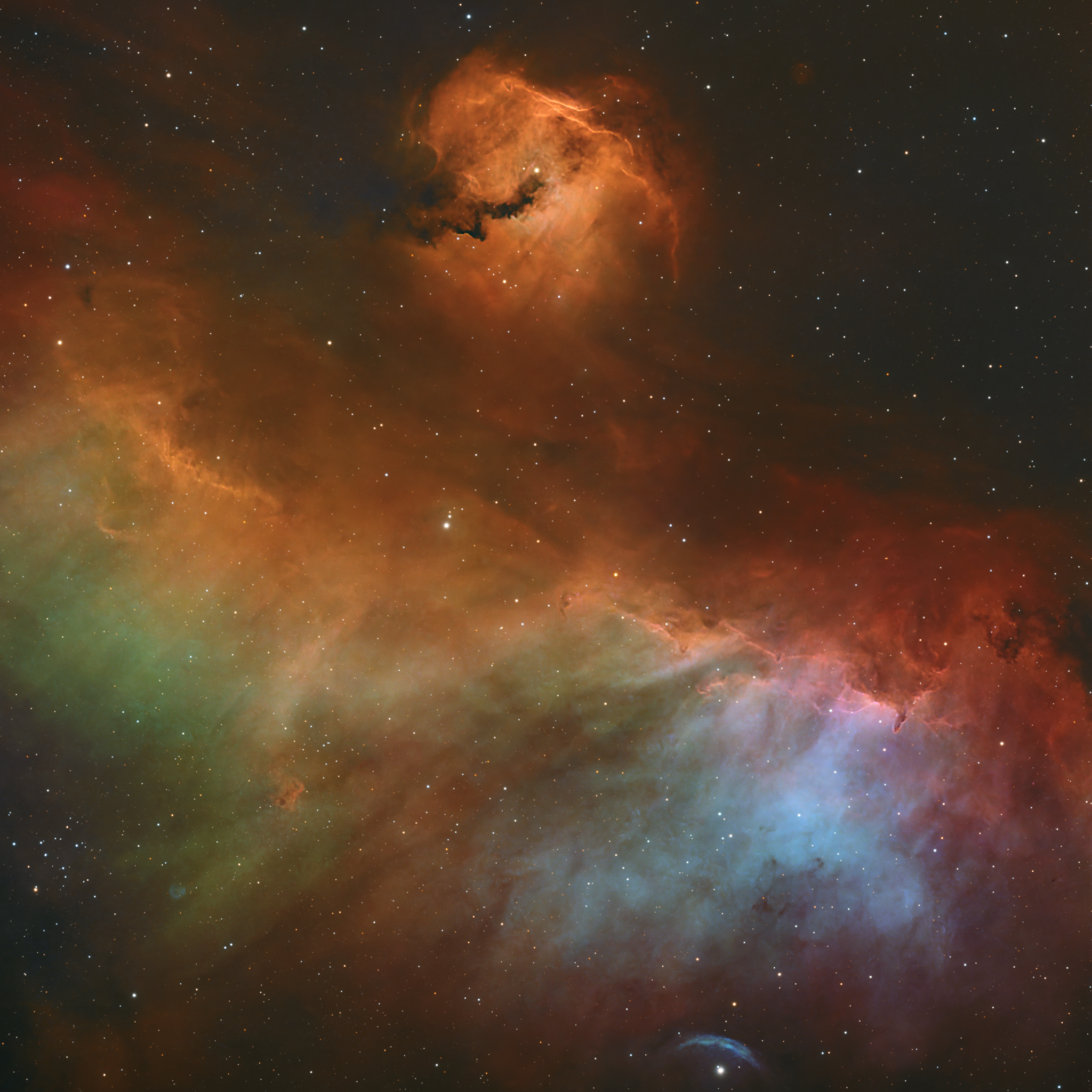
IC 2177 is a large emission nebula straddling the border of Monoceros and Canis Major, roughly 3,800 light-years away. The popular name comes naturally — the structure genuinely resembles a gull in flight, with broad sweeping wings of ionised gas extending across several degrees of sky and a distinct head region at the upper centre. That head, catalogued separately as NGC 2327, is a compact bright-rimmed knot of dense gas being driven into a tight glowing bubble by the hot stars embedded within it, sitting above the sweeping wing like a bird craning its neck into the wind.
The wing structure itself is a classic example of a swept bow shock — a vast arc of gas compressed and ionised where the expanding HII region meets the surrounding molecular cloud. The HOO palette here reveals the full complexity of that interaction: the warm hydrogen tones dominating the body and upper wing, transitioning into the cooler oxygen-III blues along the lower edge where the ionisation front is sharpest. That diagonal sweep from orange through green into ice blue is one of the most satisfying colour gradients in any southern target, and this image captures the full extent of it without losing the fine structure along the rim.
The bottom of the frame catches a faint reflection nebula arc — a quieter counterpoint to all that ionised drama above.
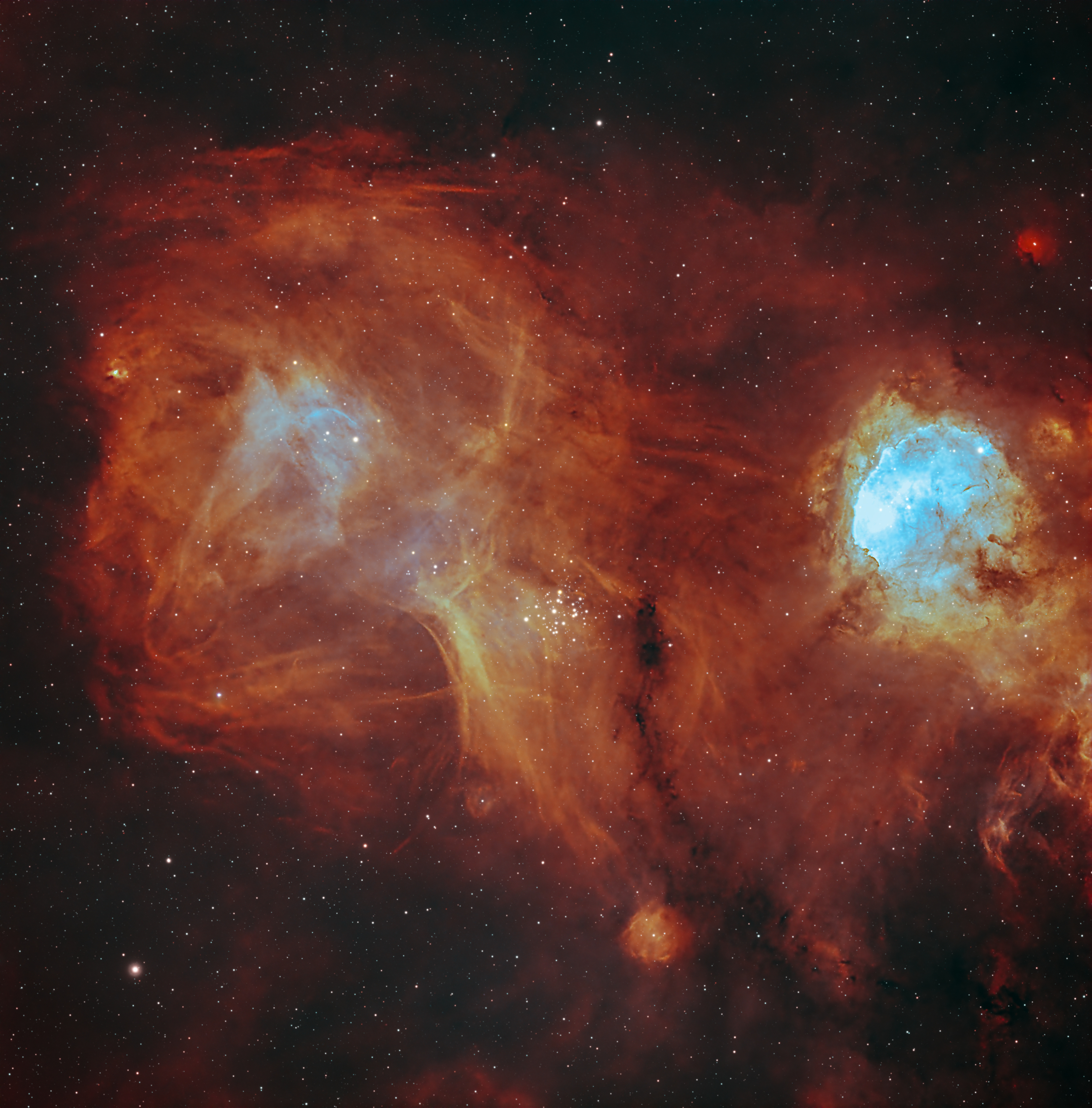
NGC 3324 and NGC 3293 share a field in Carina that rewards wide-field treatment more than almost anything else in the southern sky. The large swept structure dominating the left is the NGC 3293 Gem Cluster region — a sprawling complex of ionised gas and embedded young stars whose warm hydrogen emission fills the frame in deep amber and copper, loops of glowing gas arcing outward from the central cluster in great curving forms driven by stellar winds and radiation pressure.
On the right, the Gabriela Mistral Nebula blazes in oxygen-III blue — NGC 3324's hottest stars driving fierce ionisation into the surrounding molecular cloud, the resulting OIII emission reading almost luminous against all that warm hydrogen behind it. The name comes from a fanciful reading of the bright rim structure as the profile of the Chilean poet, but the physics behind it is straightforward: a classic bright-rimmed cloud being photoevaporated from the near side, with the ionisation front working its way steadily into the cold gas behind. The HOO palette makes that contrast between the two regions particularly vivid — the cool blue of the Mistral set against the broad warm sweep of the Gem Cluster field like two different conversations happening in the same room.
Between them a dark molecular lane threads across the frame, cold and unlit, the raw material from which the next generation of stars in this complex will eventually form.
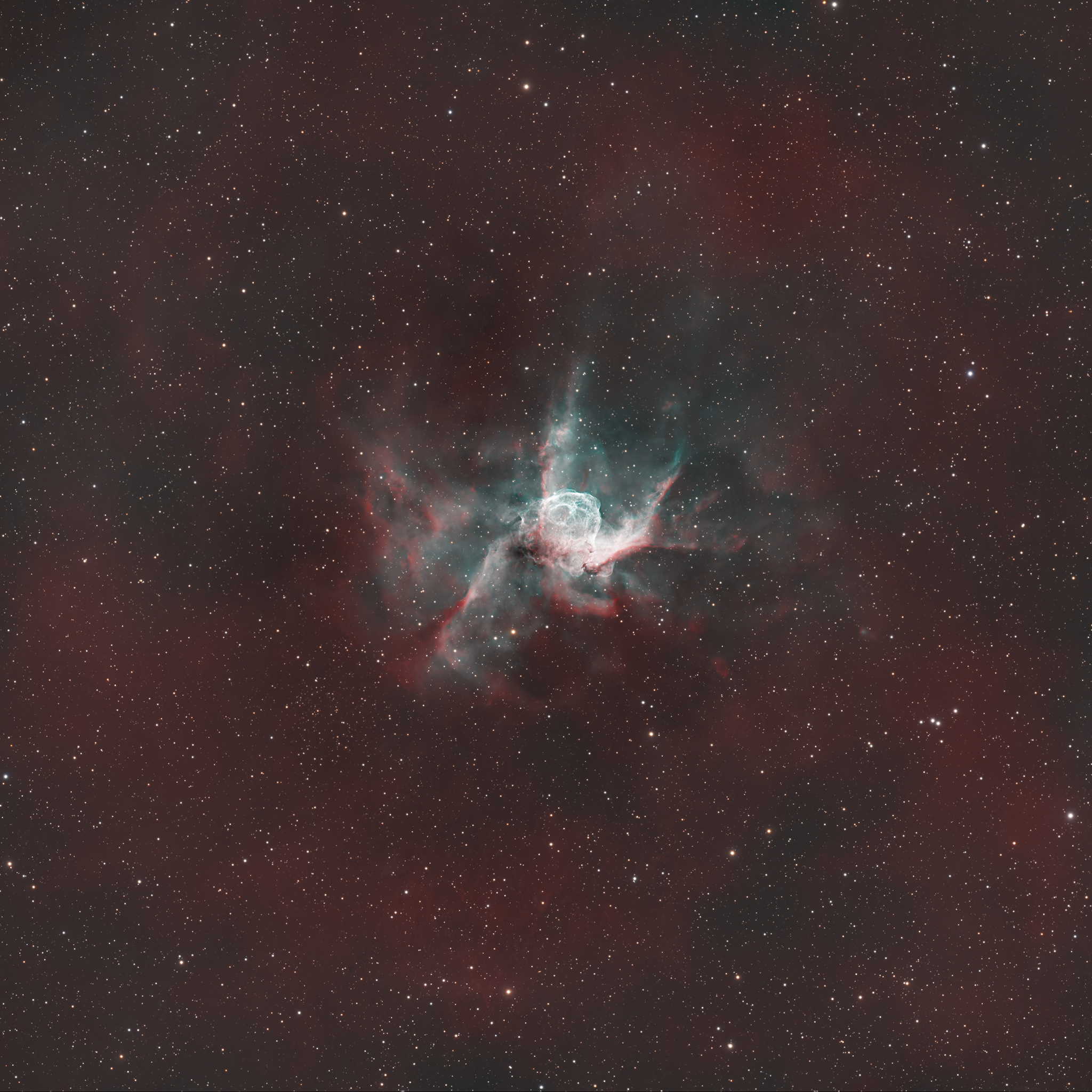
NGC 2359, named for its distinctive winged bubble structure, is a Wolf-Rayet bubble nebula approximately 12,000 light-years away in Canis Major. Unlike most emission nebulae powered by clusters of hot stars, this one is driven almost entirely by a single extraordinary object: Wolf-Rayet star HD 56925 — one of the rarest stellar types in the galaxy. Wolf-Rayet stars have blown away their outer hydrogen envelopes entirely, exposing the hot helium-burning cores beneath.
HD 56925 has a surface temperature exceeding 50,000 Kelvin and drives a stellar wind at up to 1,800 km/s, carrying away mass at millions of times the solar wind rate. This ferocious wind has excavated and shaped the bubble over thousands of years. The "wings" of the helmet form where the bubble interacts asymmetrically with denser surrounding material. The HOO palette renders the oxygen-III-rich central bubble in luminous teal-white, while surrounding hydrogen emission forms delicate pink-red wisps.
HD 56925 is nearing the end of its brief violent life — Wolf-Rayet stars are destined to explode as Type Ib or Ic supernovae, leaving behind either a neutron star or a black hole. The nebula we see today is, in the most literal sense, a dying star's last exhalation.
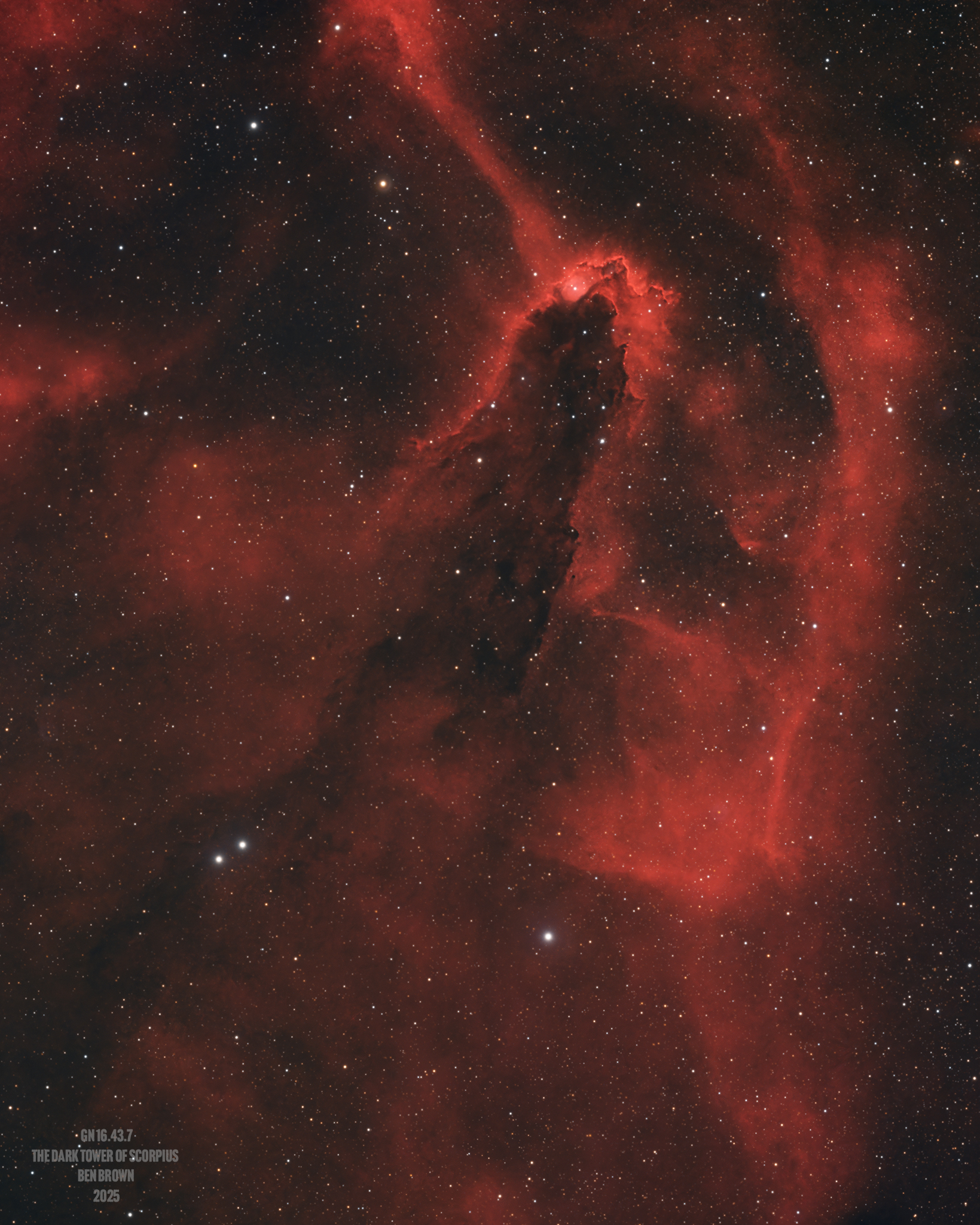
The Dark Tower of Scorpius, catalogued as GN 16.43.7, is one of the most visually arresting and least-observed dark nebulae in the southern sky. This towering pillar of opaque molecular gas and dust rises dramatically against a sea of hydrogen-alpha emission in Scorpius, resembling a gothic monolith seen from space. Best captured in pure hydrogen-alpha light — exactly the approach I've taken here — the result is a moody, high-contrast image that is all the more powerful for its chromatic restraint.
Dark nebulae are visible only because they block the light of emission nebulae or star fields behind them. The Dark Tower is a dense concentration of molecular gas and dust, likely part of the Scorpius-Centaurus OB Association star-forming region. Its survival as a coherent structure is remarkable given the intense radiation environment of Scorpius, where multiple hot O and B-type stars bathe the surroundings in ultraviolet light. The tip of the pillar glows faintly — an ionisation front where radiation is currently eating into the molecular material atom by atom.
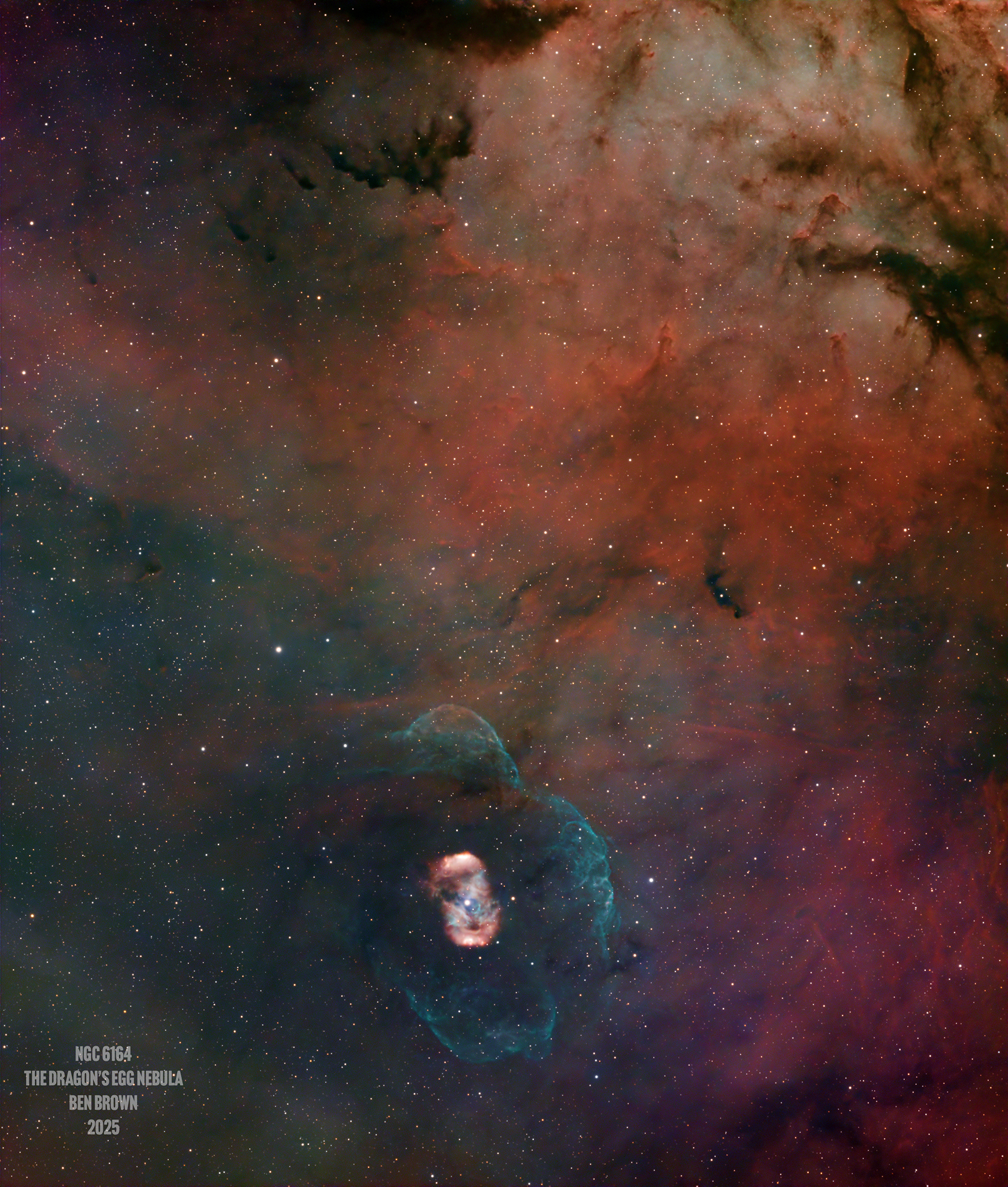
NGC 6164-6165, the Dragon's Egg Nebula, is approximately 4,200 light-years away in the constellation Norma. Unlike a true planetary nebula, it is a bipolar emission nebula created by HD 148937 — a magnetic O-type star, one of only a handful of such stars known in the entire Milky Way. The powerful magnetic field of HD 148937 channels the stellar wind into two opposing lobes of ejected material, creating the symmetric bipolar egg structure visible here. The glowing oval shell is material shed over the past 7,000 years or so.
Recent studies suggest HD 148937 may have undergone a stellar merger event — the magnetic field and bipolar nebula structure may both be remnants of a violent collision between two massive stars in the system's past. The Dragon's Egg may, in the most literal sense, be a stellar crime scene, its strange symmetry and unusual magnetism the fingerprints of a cosmic collision. My inspired framing sets this delicate nebula within its spectacular context: the vast red hydrogen-alpha emission from Norma's surrounding star-forming complex.
The Dragon's Egg floats against this fiery backdrop like a luminous jewel — the teal glow of its oxygen-III-rich shell contrasting dramatically against the background red. The surrounding field reveals dust lanes, filaments, and diffuse nebulosity that would be a photographic target in their own right.
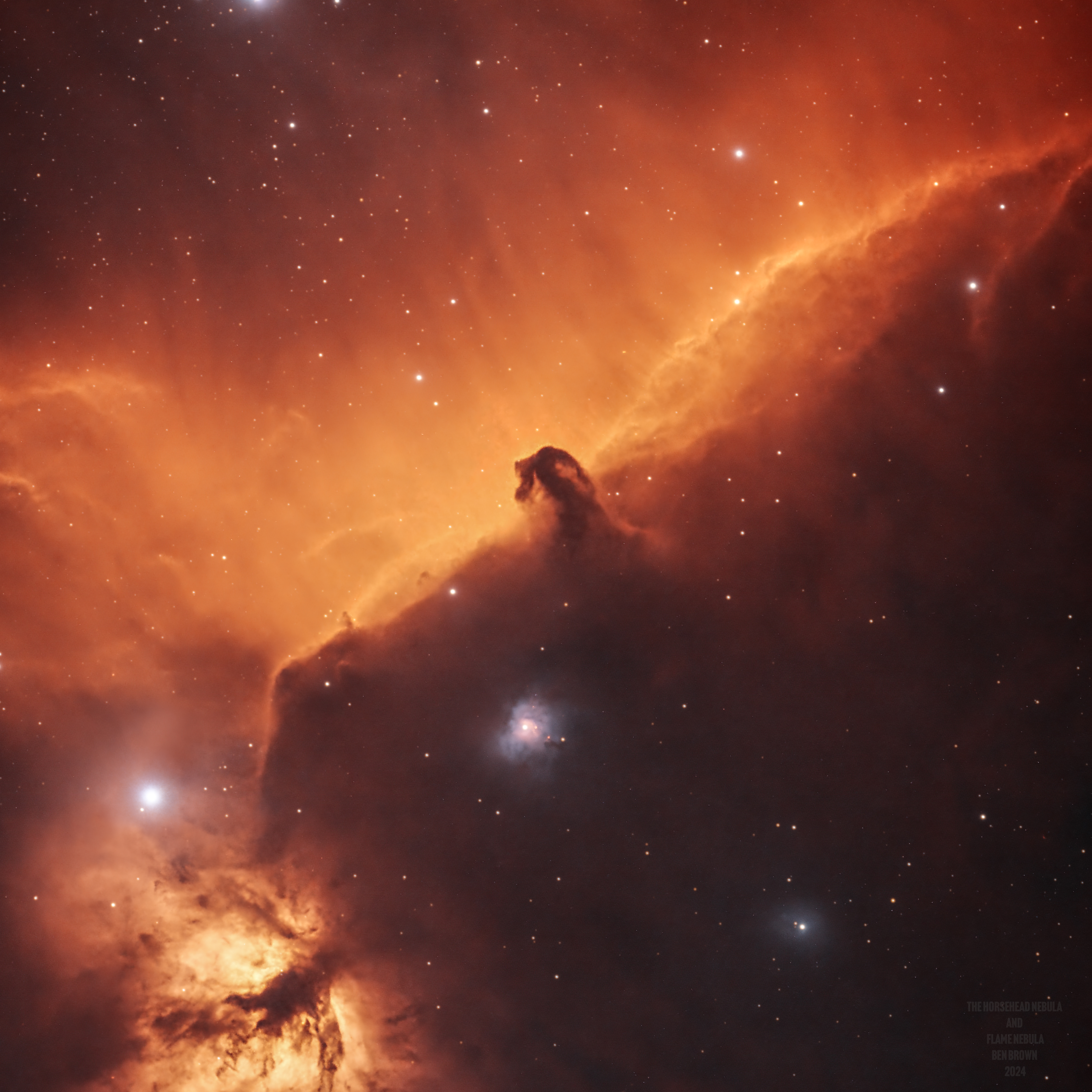
The Horsehead and Flame Nebulae are arguably the most iconic pairing in all of deep-sky astrophotography. Located approximately 1,375 light-years away in Orion — among the nearest star-forming regions to Earth — these objects have become symbols of the visual power of nebular astronomy since their discovery on photographic plates in the late 19th century. My image captures both in a single richly detailed field.
The Horsehead Nebula, Barnard 33, is a dark nebula: a dense pillar of cold molecular gas silhouetted against bright emission nebula IC 434 behind it. The distinctive horse's-head profile is a protrusion from a much larger molecular cloud approximately 3.5 light-years tall, being actively eroded by radiation from the nearby bright star Sigma Orionis. The Flame Nebula, NGC 2024, is an emission nebula illuminated by Alnitak — the easternmost star of Orion's Belt — one of the hottest and brightest stars in the night sky. The dark lane bisecting the Flame is an obscuring cloud of dust between us and the emission behind it.
My warm amber palette emphasises the rich thermal texture of both objects. The Horsehead stands in dramatic silhouette against glowing amber emission while the Flame blazes with internal structure. Perhaps the most beloved target in all of astrophotography, captured from my backyard in Western Australia.
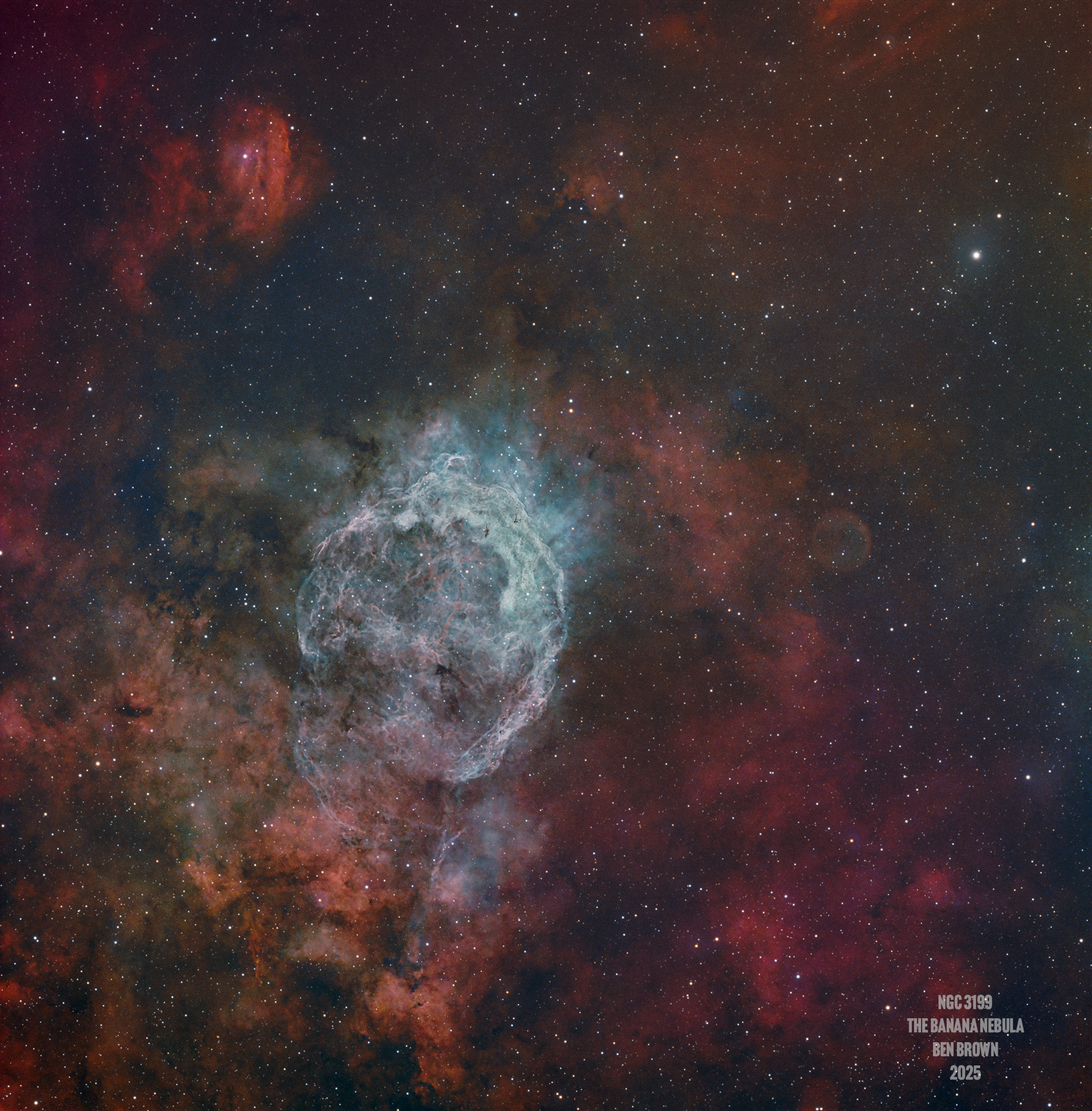
NGC 3199 is a wind-blown nebula approximately 12,000 light-years away in Carina, nicknamed the Banana Nebula for the pronounced arc of bright emission curving across its face. Like Thor's Helmet, this is a Wolf-Rayet bubble — shaped and energised by the extreme stellar wind of Wolf-Rayet star WR 18 at its heart. WR 18 is a WN4-type Wolf-Rayet star that has stripped away its own outer envelope and now drives a ferocious wind of ionised particles outward at thousands of km/s.
This wind has swept up the surrounding interstellar medium into a roughly spherical bubble over tens of thousands of years. However, the bubble is far from symmetric — the distinctive bright arc on one side is considerably brighter and more compressed than the rest of the shell. Two hypotheses compete: either WR 18 is a runaway star creating a bow shock as it moves supersonically through the interstellar medium, or the surrounding medium is simply denser on that side. Current evidence slightly favours the density variation hypothesis, but the question is not definitively settled.
My HSO rendering showcases the extraordinary delicacy of the bubble's shell — a lace-like network of filaments visible at high resolution.
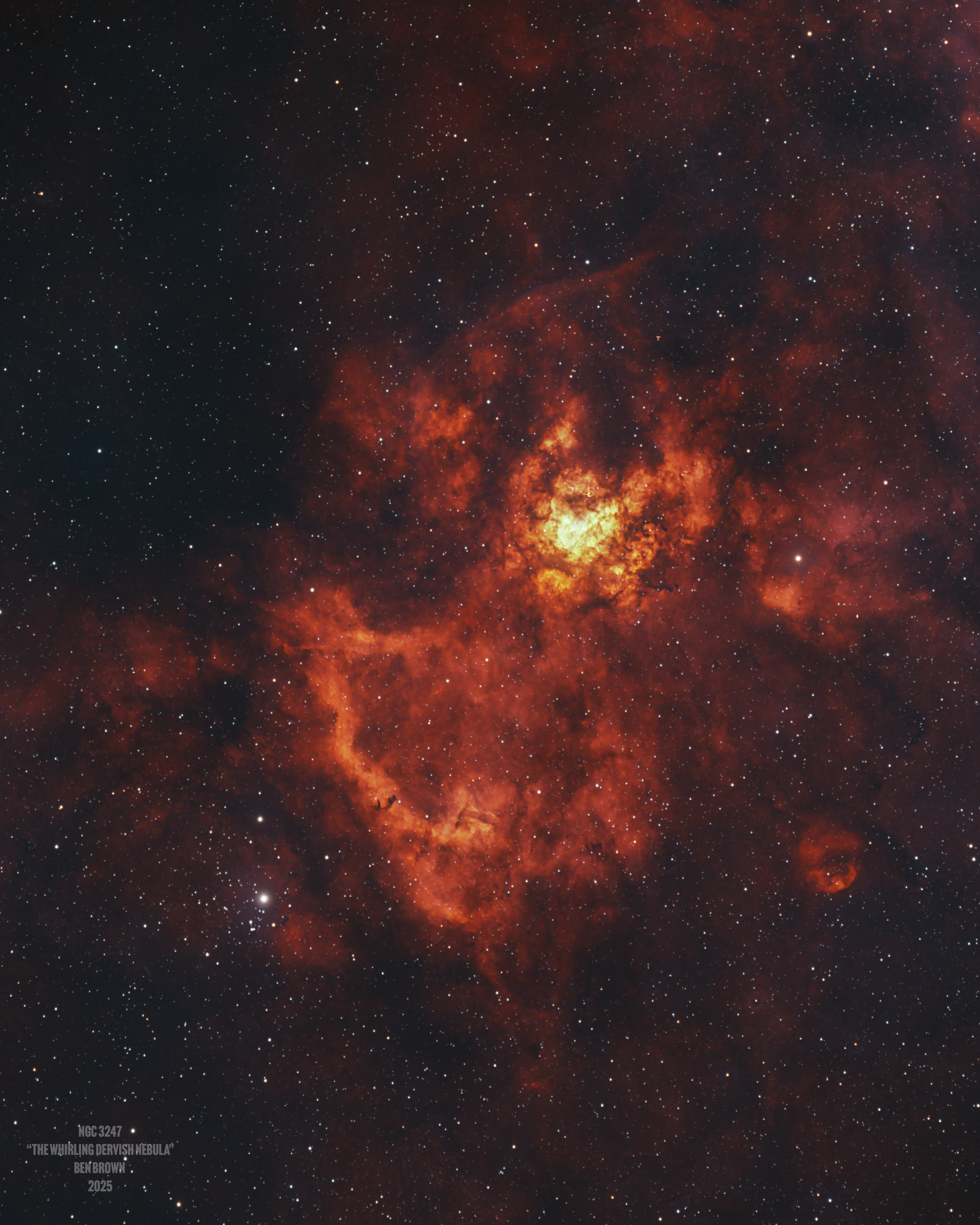
NGC 3247 is a luminous HII region and star-forming complex deep in the constellation Carina — a part of sky so rich in nebulosity that almost any direction yields something extraordinary.Nicknamed the Whirling Dervish, I captured the swirling chaotic energy of this complex in a warm golden-orange hydrogen-alpha palette that feels simultaneously scientific and painterly. The bright core of NGC 3247 contains the most recently formed massive stars, blazing intensely in the upper portion of the frame.
HII regions like this are the engines of galactic evolution. They are vast clouds of ionised hydrogen where conditions are exactly right for the collapse of molecular gas into protostars. The hot young stars born within then ionise their surroundings while their winds and eventual supernova explosions inject turbulence and heavy elements back into the medium, seeding the next generation of stars. The swirling knotted structure reflects turbulent hydrodynamics — radiation-driven instabilities, stellar wind bubbles, and the complex interplay between ionised and neutral gas creating the characteristic filamentary, almost fractal texture visible at all scales.
The result glows like a coal — deep amber at the edges, intensifying to fierce yellow-white at the core. A distinctive and scientifically revealing image from an often-overlooked target.
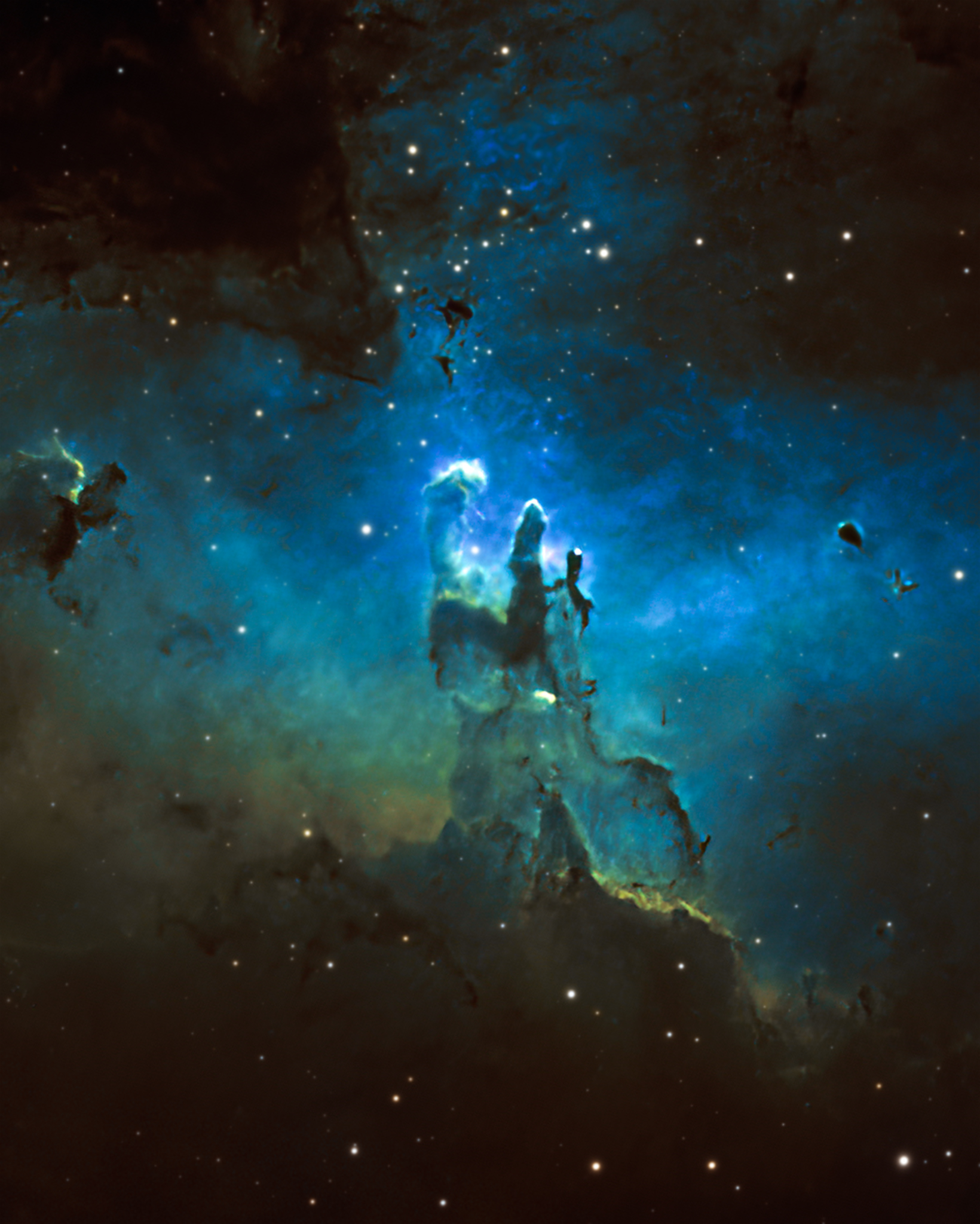
The Eagle Nebula, Messier 16, is one of the most celebrated objects in all of astronomy — and its innermost jewel, the Pillars of Creation, became perhaps the single most famous astronomical image ever taken when the Hubble Space Telescope first photographed them in 1995. My rendition reveals the extraordinary structure of these molecular towers in teal and gold narrowband light from Western Australia.
Located 7,000 light-years away in Serpens, the hot O-type stars of embedded cluster NGC 6611 have cleared much of the surrounding gas, but dense columns of molecular material have resisted the onslaught — these are the Pillars of Creation. The tallest pillar extends roughly 4 light-years from base to tip. The pillars are classic Evaporating Gaseous Globules (EGGs), with finger-like protrusions at their tips being potential sites of new star formation protected within the molecular cloud interior. The pillar surfaces glow with a thin ionisation front where radiation is actively boiling molecular gas away over millions of years.
My SHO treatment renders the oxygen-III-rich environment in luminous teal, while hydrogen and sulphur regions appear in warmer green and gold. The result differs strikingly from the famous Hubble palette — offering an equally valid window into the physics of these structures. The dark dense cores set against the glowing ionised background create a composition of depth and drama in this iconic subject.
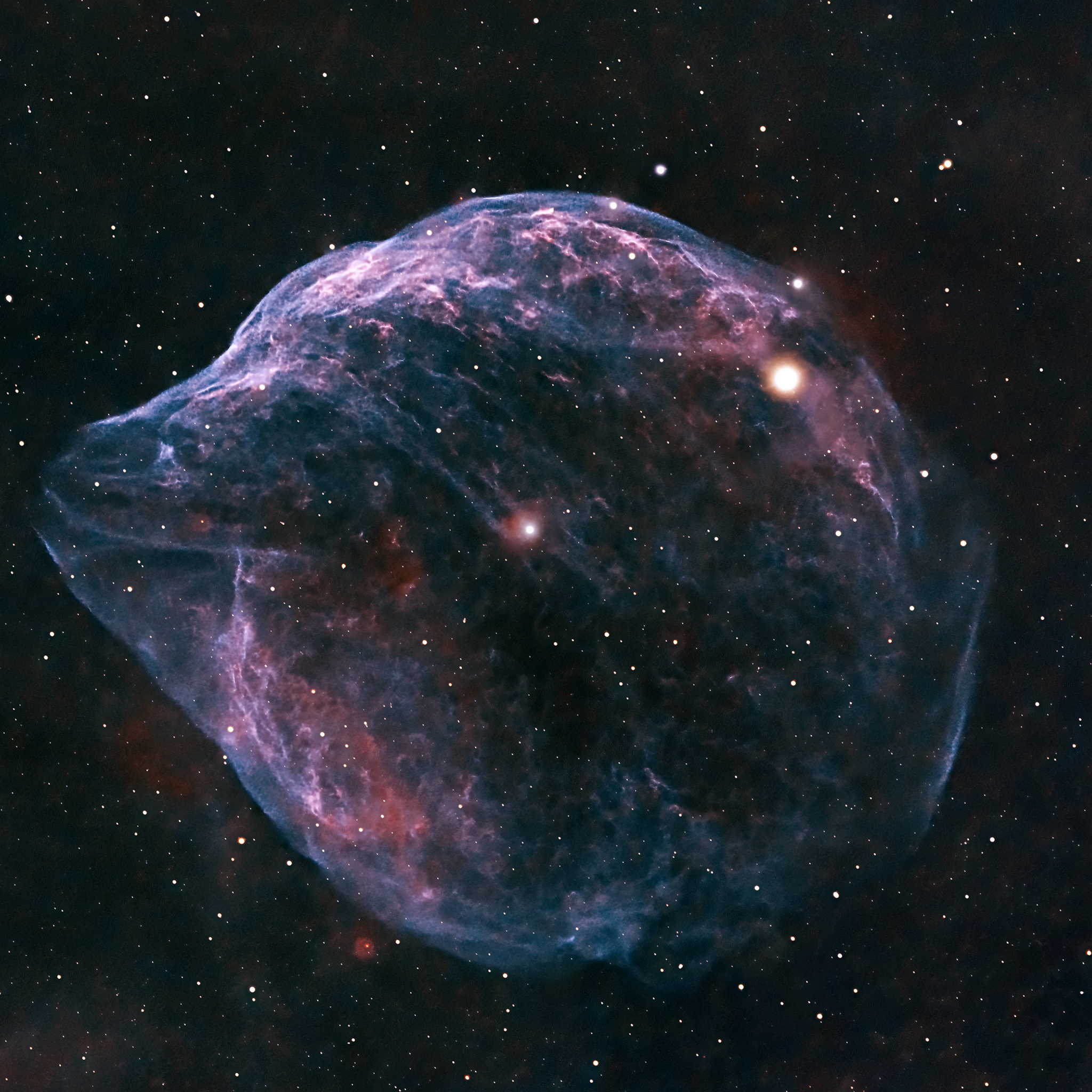
Sharpless 2-308, the Dolphin Nebula, is a Wolf-Rayet bubble approximately 4,500 light-years away in Canis Major. Driven by Wolf-Rayet star EZ Canis Majoris (WR 6), this near-perfectly spherical shell of ionised gas represents the accumulated output of thousands of years of ferocious stellar wind energy. Its soft rounded shape and blue-purple tones in narrowband imaging give it the gentle appearance that inspired its cetacean nickname — belying the violent physics behind it.
EZ Canis Majoris is a WN4-type Wolf-Rayet star with one of the most powerful stellar winds known — moving at approximately 1,700 km/s and carrying away mass at rates millions of times greater than the solar wind. It is estimated to be losing mass so rapidly it will explode as a Type Ib supernova within a few million years. The bubble's near-perfect spherical symmetry suggests the star is not moving rapidly relative to the surrounding medium and that the surrounding interstellar density is relatively uniform in all directions. The thin filamentary shell at the bubble boundary is an ionisation front propagating outward as the wind sweeps up and excites surrounding gas.
My HOO image renders the Dolphin in beautiful blue-purple tones dominated by oxygen-III emission, surrounded by a faint halo of hydrogen-alpha in red. The near-perfect spherical geometry, delicate filamentary shell texture, and bright crescent of enhanced emission on one side create a composition of quiet elegance. A revealing capture of a visually subtle but physically extraordinary object.
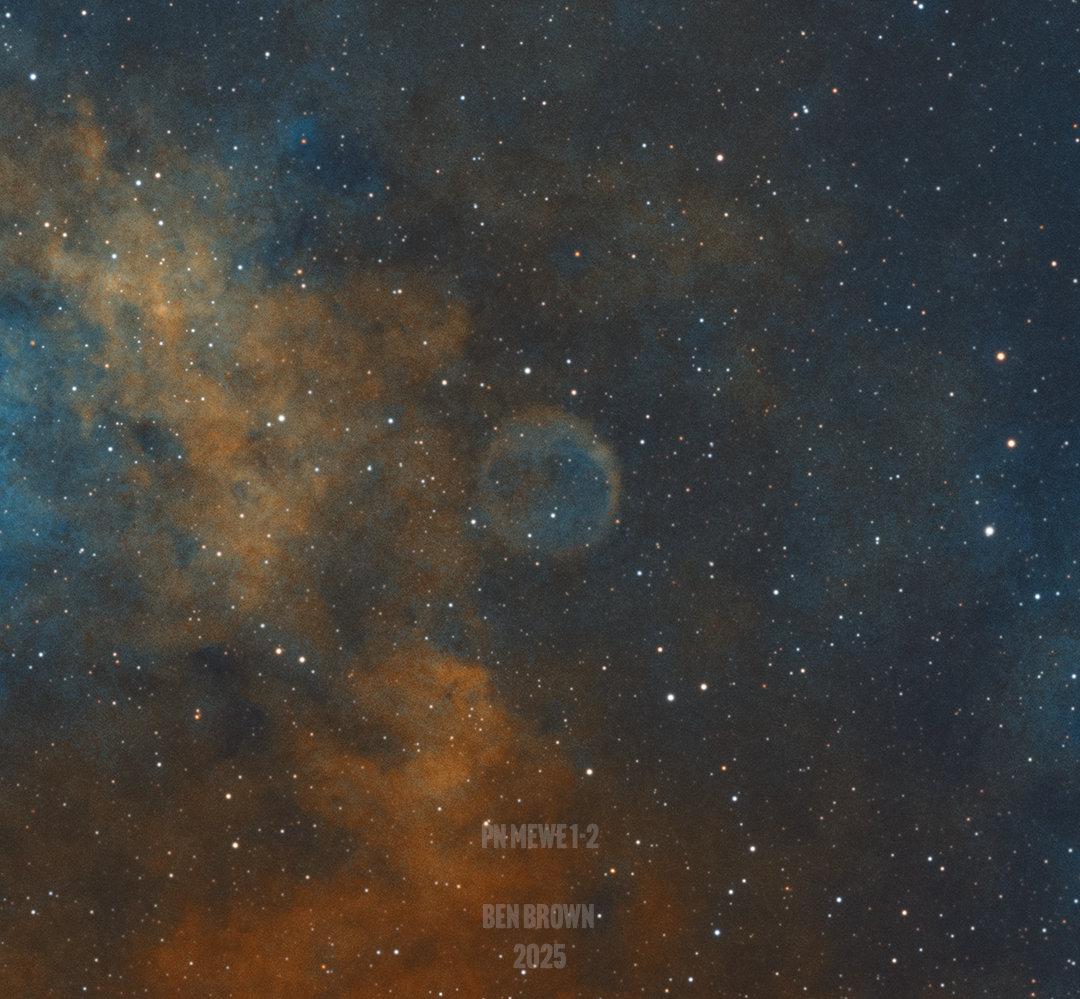
PN MeWe 1-2 is an obscure and scientifically fascinating planetary nebula embedded within the rich emission field of the Vela constellation. Discovered and catalogued by Melmer and Weinberger.
Planetary nebulae — despite the misleading name coined by William Herschel — have nothing to do with planets. They are the final exhalations of medium-mass stars like our own Sun. When a star of roughly 1–8 solar masses exhausts its nuclear fuel, it expands into a red giant and sheds its outer envelope in a series of increasingly intense stellar wind episodes. The hot compact white dwarf core left behind then ionises this ejected shell, causing it to glow. This process created PN MeWe 1-2, now glowing in the constellation Vela as a tiny luminous relic of a dead star's final chapter.
The compact crescent-ring structure visible in My image shows the ionised shell glowing in oxygen-III emission — the teal arc standing out clearly against the golden-orange background of diffuse Vela emission. The asymmetric brightness distribution may indicate the influence of a binary companion or an inhomogeneous surrounding medium.
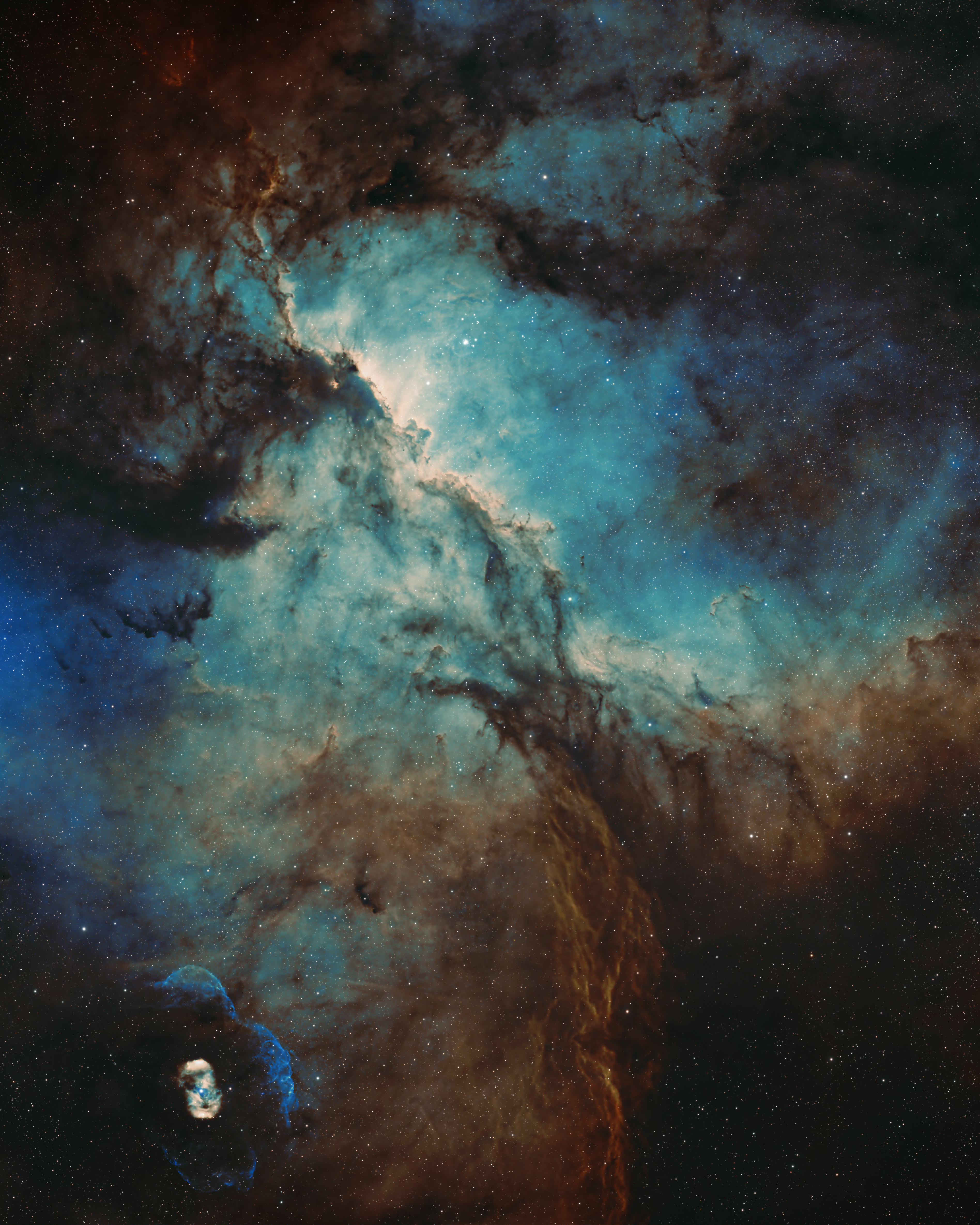
The Dragons of Ara is a wide-field rendition of the NGC 6188 region in the constellation Ara, capturing sweeping dragon-like forms of ionised gas pillars alongside the Dragon's Egg Nebula (NGC 6164-6165) in the same frame. This region, roughly 4,000 light-years away, is one of the most dramatic targets in the southern sky — a landscape of enormous scale where the forces of stellar birth and destruction play out across dozens of light-years simultaneously.
NGC 6188 is a large emission nebula illuminated by the young hot stars of open cluster NGC 6193, which formed from the same molecular cloud within the last few million years. The rim nebula — the bright irregular edge of ionised gas — marks the boundary between the HII region and the cold molecular cloud beyond. The "dragons" are great pillars of dark molecular gas projecting into the HII region, sculpted by radiation pressure into curving, wing-like forms. In the same field, NGC 6164-6165 floats as a separate smaller structure created by the rare magnetic O-type star HD 148937, physically located at a similar distance.
The juxtaposition of the grand sculpted dragons of NGC 6188 with the elegant bipolar egg of NGC 6164 in a single frame is unique to this region of sky. My 2024 SHO treatment covers a large area with good uniformity and detail, the wide-field perspective revealing the extended diffuse emission connecting the various bright nebulae — the invisible molecular scaffolding of a star-forming complex made visible in narrowband light.
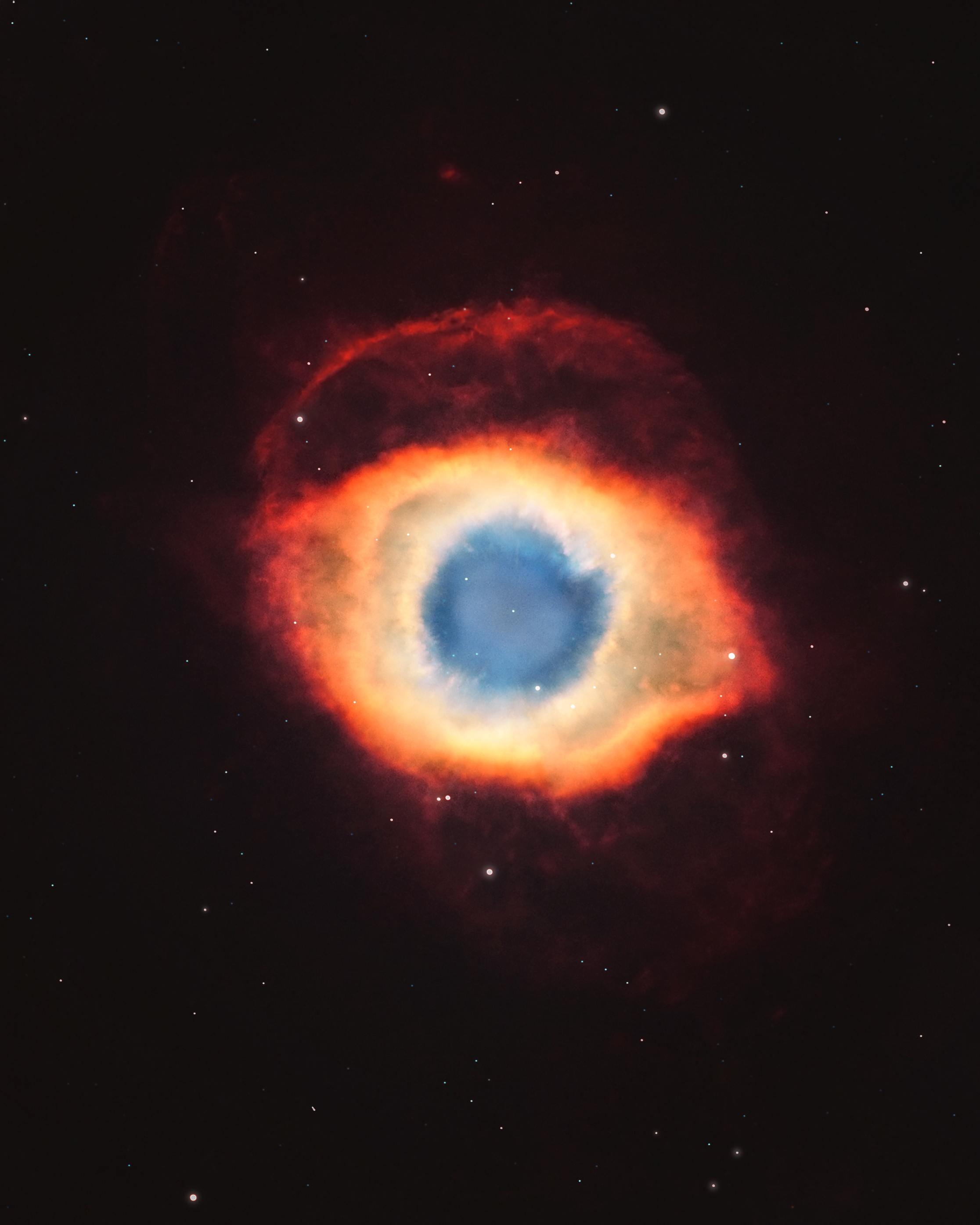
The Helix Nebula, NGC 7293, is the closest large planetary nebula to Earth at approximately 655 light-years, making it the largest planetary nebula on the sky by apparent size — nearly three full moons in diameter. Its extraordinary structure has earned it the popular nickname the Eye of God, and it is one of the most studied end-of-life stellar objects in the universe. My rendering captures it with exceptional colour separation and structural detail.
The Helix was created when its progenitor star — a medium-mass star similar to our own Sun — shed its outer envelope over roughly 10,000 years as it died. The remaining white dwarf at the centre has a surface temperature of approximately 120,000 Kelvin, ionising the surrounding expelled shells. The structure is not a single shell but a complex overlapping series of ejection events creating the subtle helix form visible on deep images. The inner region contains thousands of cometary knots — small dense nodules of molecular gas each roughly the size of our solar system, with tail-like structures pointing radially away from the central star.
My image renders the Helix in striking red-orange outer ring contrasting against deep blue-teal inner zone — the classic bicolour signature where outer hydrogen-alpha emission gives way to inner oxygen-III dominated plasma. The perfectly oval form, sharp inner torus, and faint outer halo of extended material are all captured in this image. This is our Sun's fate — five billion years from now, a profoundly moving thought.
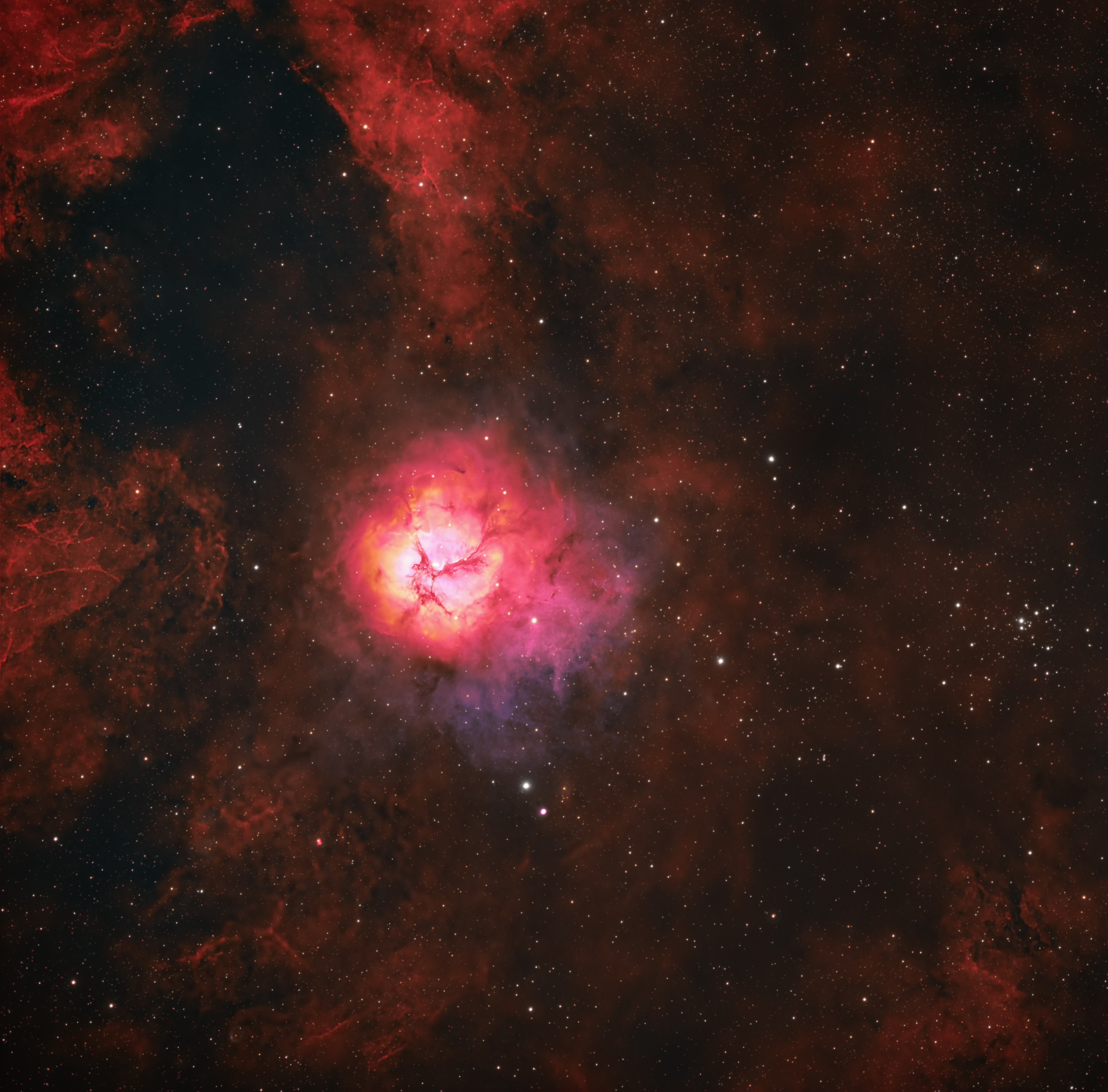
The Trifid Nebula sits about 5,200 light-years away in Sagittarius, tucked into one of the richest stretches of the southern Milky Way — and it's one of those targets that rewards you every time you come back to it. What makes M20 special is that you're getting three completely different types of nebula in one frame. The upper lobes are classic emission — hydrogen gas lit up by a hot young star system at the centre, HD 164492, burning bright enough to ionise everything around it. Those dark lanes cutting through it aren't gaps in the nebula, they're thick ridges of cold dust sitting in front of the glowing gas, dividing the whole structure into the three chambers that give it its name. Then below the core, the mood shifts entirely — a quieter reflection nebula where a loose cluster of young stars scatter their light rather than ionise anything, giving that softer blue-violet tone against all that red.
The wider field here is what elevates it beyond a simple object portrait. The deep Ha data pulls out the extended diffuse emission surrounding M20 — the broader molecular cloud complex it was born from, still glowing faintly across a huge area of sky. The Trifid isn't a standalone structure, it's one lit window in a much larger building. There's something satisfying about an image that holds all of that at once — the intimate detail of the dust lanes and the glowing core, and then all that open space around it reminding you of the scale of what you're actually looking at.
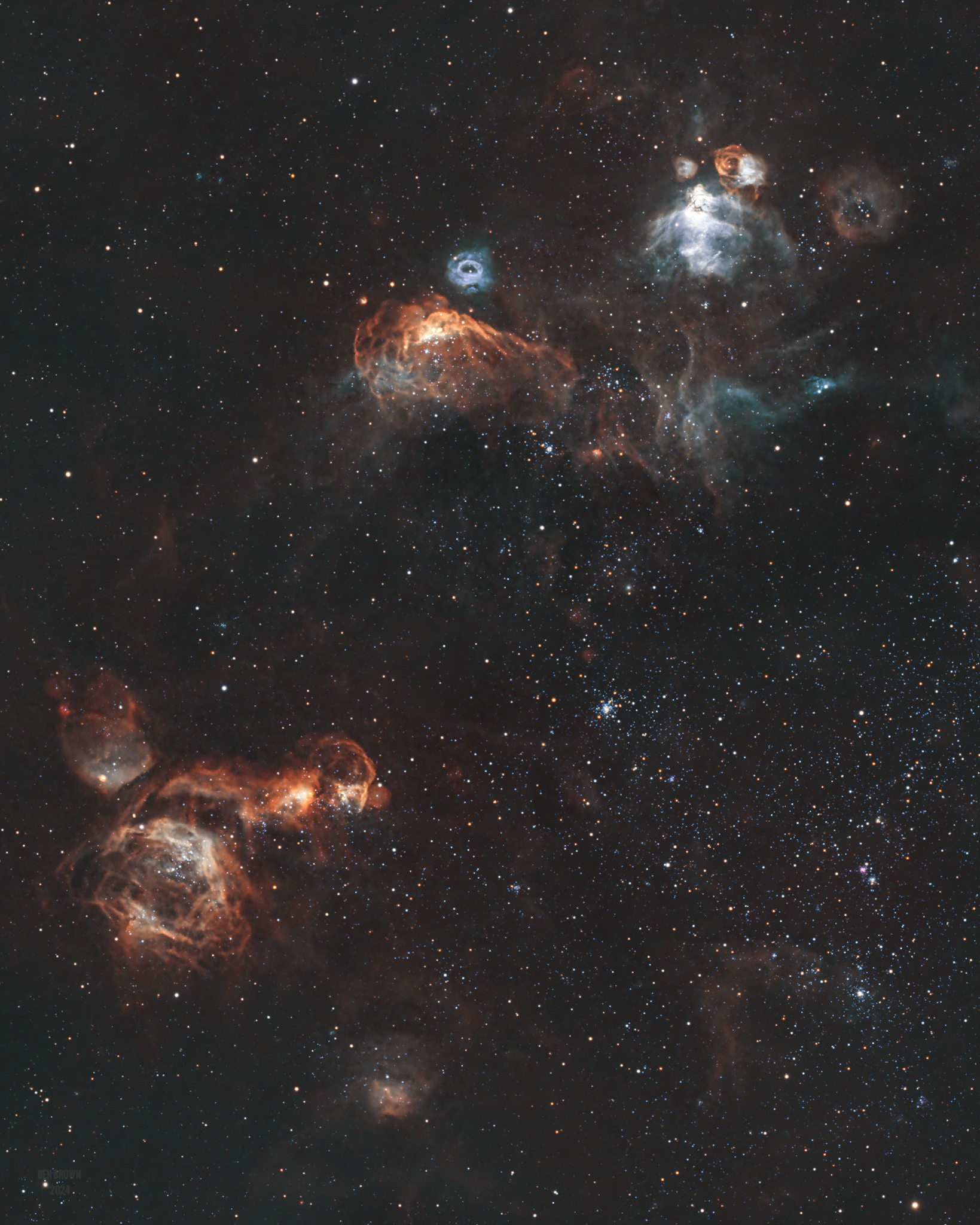
A wide-field mosaic spanning the rich nebular territory of the Fornax-Dorado border region, capturing multiple emission nebulae, star clusters, and diffuse structures in a single monumental frame. The upper portion grazes the outskirts of the Large Magellanic Cloud's most active star-forming regions, while the lower field reveals spectacular HII regions in the Milky Way's southern reaches. The multiple bright nebulae visible at various scales demonstrate the extraordinary richness of the southern sky in this direction.
Wide-field mosaic imaging of this kind requires attention to sky quality, tracking precision, and image registration across multiple panels. The result is a window onto the southern sky that conveys both the intimate detail of individual nebulae and the vast scale of the galactic landscape they inhabit.
I'm an astrophotographer based in Perth, Western Australia — imaging from a Bortle 8/9 backyard in the suburbs, which means I rely entirely on narrowband filtering to cut through the light pollution and pull faint deep sky objects out of the glow. The southern hemisphere is an extraordinary place to do this work. Objects that northern hemisphere imagers can barely glimpse are directly overhead for me — the Carina Nebula, the Centaurus complex, the Ara region — all rising high and offering long capture windows that produce the kind of images you see in this collection.
Every image here represents hours — sometimes dozens of hours — of data collection, stacking, calibration and processing. Narrowband imaging in SHO, HSO and HaOiii palettes transforms light pollution from an obstacle into a non-issue, and produces images with a visual character all their own.
Broadband imaging collects all visible wavelengths at once — and in a Bortle 8/9 sky, the vast majority of that signal is scattered sodium streetlight, LED glow, and atmospheric emission bouncing off every water droplet and dust particle overhead. The sky background overwhelms faint nebular signal within minutes. Traditional RGB astrophotography under these conditions is largely futile.
Narrowband filters work differently. The Optolong L-Ultimate and L-Synergy I use are dual-narrowband filters that pass only extremely precise wavelength bands: hydrogen-alpha, oxygen-III and Sulfur II. These are some the exact emission lines produced by ionised gas in deep sky nebulae. Everything else — sodium lamps at 589nm, LED broadband, mercury vapour, skyglow — is physically blocked by the filter coating, rejected before it ever reaches the sensor.
The result: my camera sees nebula signal against a dark background even with streetlights visible from the backyard. Integration time matters more than sky darkness when you're imaging this way. More hours means more signal. The filters solve the background. Time solves the noise. Under narrowband, a Bortle 8/9 suburban sky can produce images sometimes indistinguishable — in signal depth — to those taken from dark sites with broadband filters.
Light pollution is not an obstacle. It's just a filter problem.